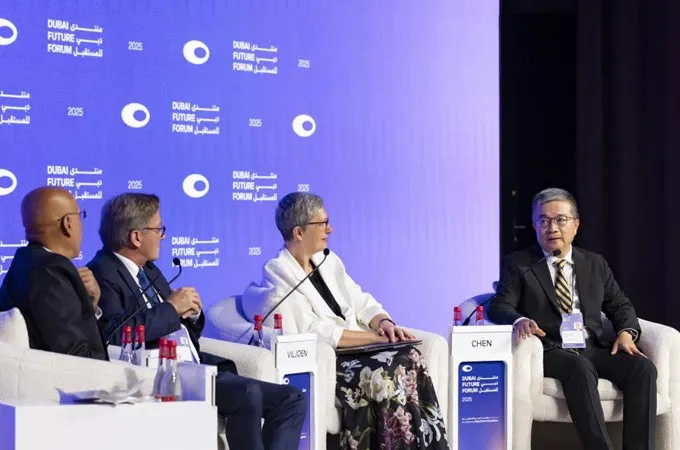
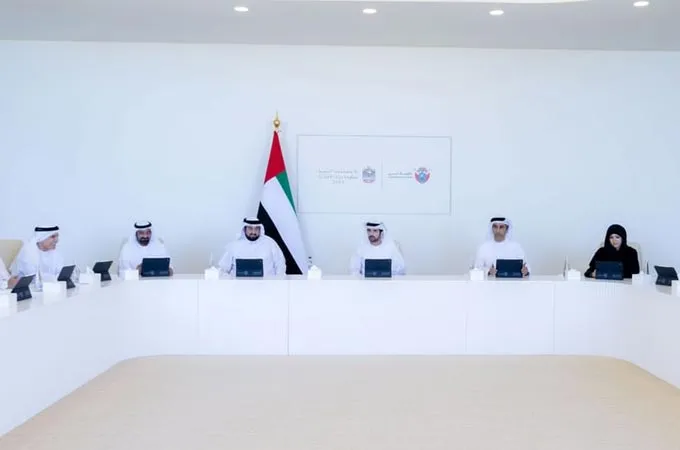
Emerging technologies, coordinated governance and collective action are essential to build a secure, sustainable and equitable future, experts said at the World Economic Forum Annual Meetings of the Global Future Councils and Cybersecurity in Dubai.
The Annual Meeting on Cybersecurity, held jointly with the Global Future Councils, focused on strengthening global cooperation to enhance digital trust, resilience and collective readiness for emerging threats.
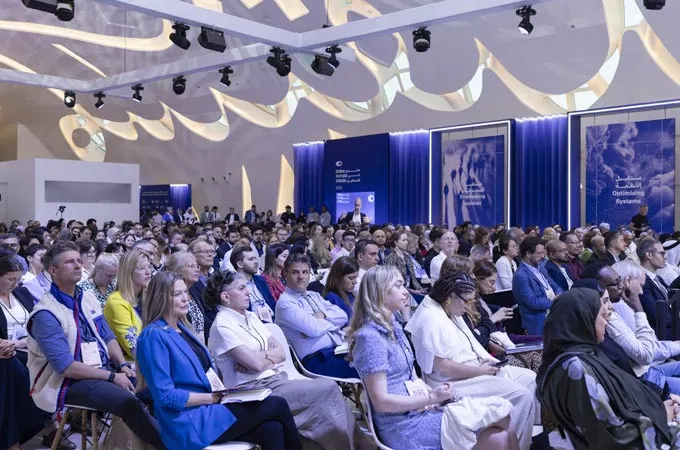
Over 500 thought leaders and 150 cybersecurity leaders gathered in Dubai for a special joint session of the Annual Meetings of the Global Future Councils and Cybersecurity.
The meetings – organized in collaboration with the Government of the United Arab Emirates – provided a vital platform to navigate uncertainty, interpret emerging trends and strengthen resilience across industries, societies and economies. Council members and cybersecurity leaders advanced future-ready solutions to interconnected shared challenges, spanning trade and geoeconomic shifts, innovation for growth and prosperity, cybersecurity, climate action, food innovation, health and the energy transition.
"In this new, more uncertain era, dialogue is our greatest source of innovation and resilience,” said Børge Brende, President and CEO, World Economic Forum. "Only through open exchange – across disciplines and industries, with a range of perspectives – can we unlock the ideas and trust that we need to move the world forward together.”
“The UAE’s long-standing partnership with the World Economic Forum has evolved the Global Future Councils into a platform for collective foresight and global action, addressing the opportunities and risks of an increasingly digital and cyber-driven world,” said Mohammad Abdullah Al Gergawi, Minister of Cabinet Affairs of the United Arab Emirates and Co-Chairman of the Global Future Councils. “This collaboration reflects our shared commitment to transforming vision into practice and ensuring societies are equipped for the transformations ahead.”
Discussions at the Annual Meetings highlighted the forum’s unique ability to connect future-oriented insights across disciplines and anticipate emerging risks and opportunities.
“The forum’s Global Future Councils convene diverse perspectives to translate frontier insights into action around pressing global challenges,” said Saadia Zahidi, Managing Director, World Economic Forum. “Multidisciplinary conversations such as these are essential towards ensuring that societies and businesses are ready for the opportunities and disruptions ahead.”
“The world needs a positive outlook on the future, not one that overlooks challenges but one grounded in optimism and problem-solving,” said Omar Sultan Al Olama, Minister of State for Artificial Intelligence, Digital Economy and Remote Work Applications of the United Arab Emirates. “We must move from driving forward through the rearview mirror to looking through the windshield with clarity, confidence and purpose.”
“This is the best time ever to be a human because of what we know, but we should always keep front and centre the magnitude of what we don’t know,” Sylvia Earle, Creator, Mission Blue Foundation, National Geographic Society, and Co-Chair of the Annual Meetings of the Global Future Councils and Cybersecurity 2025.
“The UN secretary-general has put together a very forward-looking agenda. The pact for the future that looks at AI, at energy, at climate. I think we’re going to see a UN that is fit for that purpose and we need a UN fit for that purpose,” said George Gray Molina, Head of Inclusive Growth and Chief Economist, United Nations Development Programme (UNDP).
“The physical world around us operates better than it ever has before. It's safer, more profitable, it's more economic and fantastic. But if it collapses, if it goes down, not all of us will understand why it took place or how to recover it,” said Robert M Lee, Chief Executive Officer and Co-Founder, Dragos.
The programme brought frontier issues into focus, with spotlights on innovation and growth in a shifting landscape, cybersecurity and other topics, including climate action, energy, health and food.
Innovation for inclusive growth
Participants identified key innovations, policies and business models that could drive meaningful and sustainable economic growth and a forward-looking agenda, focusing on competitive business environments, private investment, industrial policy and the green-digital transition. They also examined shifting economic trends and growing trade fragmentation, exploring how governments and businesses can adapt to new realities while strengthening cooperation, security and resilience.
Emerging technologies and AI were recognised as key drivers of future growth. Councils looked at the infrastructure needed to support innovation while balancing sustainability priorities and energy efficiency, highlighting the importance of adaptive strategies across diverse contexts. Experts also advanced work on space technology, committing to developing foresight scenarios to navigate critical uncertainties driving the future of the space economy. Leaders discussed how to make regulatory systems more agile and adaptive to risks posed by multiple emerging technologies.
Strategic intelligence and foresight methodologies were embedded in the UAE Strategic Intelligence Councils and other selected councils to build scenarios and define actions for policy innovation across AI, technology, trade, investment, the economy and tourism. Councils also addressed advanced manufacturing and value chains, governance frameworks, rebuilding trust and dialogue across societies, reimagining aid, as well as GovTech and digital public infrastructure.
In addition, councils advanced work on coordination, preparedness and governance in decentralized finance, the experience economy, gender parity, human capital development, robotics, generative biology, artificial general intelligence, neurotechnology and next-generation computing.
Jobs of tomorrow
The forum's Jobs of Tomorrow: Technology and the Future of the World’s Largest Workforces report highlighted how four technologies – AI, robotics, advanced energy systems and sensor networks – are set to transform seven job families that together employ 80% of the global workforce. An “output lab” on scenarios for the global economy imagined how the pace of AI development could intersect with labour market conditions over the next five years.
Participants explored how AI and shifting workforce trends could shape work by 2030, identifying strategies for businesses, labour markets and societies. A resource hub, with a key focus on financial education, was launched to share best practices, research and solutions that can be used by policy-makers, business and civil society leaders worldwide to advance financial inclusion.
“This year’s meetings showed how leaders from across sectors can come together to shape practical solutions for the future,” said Maroun Kairouz, Managing Director, World Economic Forum. “In an era of accelerating geoeconomic and technological shifts, participants explored how to strengthen resilience in trade, innovation and investment, and turn dialogue into action around shared priorities.”
AI is new oil
“AI is a new oil,” said Mohamed Al Kuwaiti, Head of Cybersecurity, United Arab Emirates Government. “It could change a lot of the way we see and deal with technology.”
“For a long time, digital transformation meant moving from paper to screen, but AI changed everything. AI will enable us to offer services through phones and to deliver them in local languages,” said Cina Lawson, Ministry of Digital Economy and Transformation of Togo.
Cybersecurity
With digital infrastructure embedded in daily life – from hospitals and airports to financial systems and democratic institutions – cybersecurity has become integral to modern life. Leaders underscored its central importance to national security, economic resilience and public trust. They called for innovation and strong governance to safeguard digital societies and the economy, and strengthened resilience across and between sectors and borders.
Bridging gaps between advanced and emerging economies – and between large enterprises and smaller organizations – was seen as vital to global cyber maturity. Recent high-profile breaches showed that resilience must extend beyond the enterprise to suppliers, partners and service providers. Shared platforms, cyber insurance and public-private training initiatives were highlighted as tools to close the “resilience gap” across industries and regions.
Participants also cautioned against applying traditional notions of sovereignty to the technological realm. Building trust across borders was seen as essential for cyber resilience, requiring aligned frameworks and sustained public-private collaboration to balance privacy, sovereignty and accountability. They highlighted practical and scalable tools to view cybersecurity and resilience through an economic lens, allowing leaders to prioritize investments where they matter most.
Climate action, food innovation, health and the energy transition
Discussions explored how emerging technologies are affecting climate action and sustainability, food innovation, health and the energy transition. Participants updated a roadmap to integrate natural capital into the global economy and advanced work on innovative financing, nature-security links, clean air, climate and nature governance, the forest economy, geoengineering and antimicrobial resistance. They also outlined a shared vision for a regenerative ocean economy grounded in science, equity and resilience, and reinforced the importance of soil health as vital to climate, nature and food security.
On energy, councils advanced work on the links between energy and water, agriculture, economic development and growth, as well as the need for an equitable green transition that works for people and planet. As part of the continued collaboration between the UAE’s Centre for the Fourth Industrial Revolution and the Forum, participants examined how social robotics are transforming healthcare, education and public spaces.
The 10 Emerging Technology Solutions for Planetary Health report spotlighted technology solutions to accelerating climate action by changing the way the world powers homes, grows food and secures freshwater. During an “output lab” dedicated to nature and climate, participants reimagined global economic systems to deliver shared prosperity within planetary boundaries. Discussions focused on integrating environmental stewardship, resilience and equity into economic design. -TradeArabia News Service