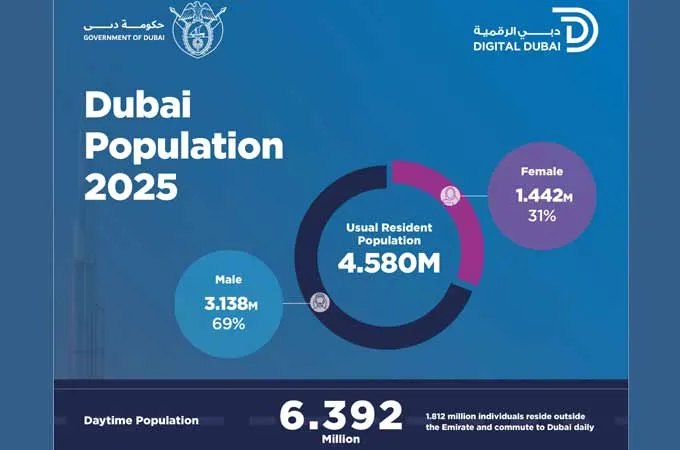
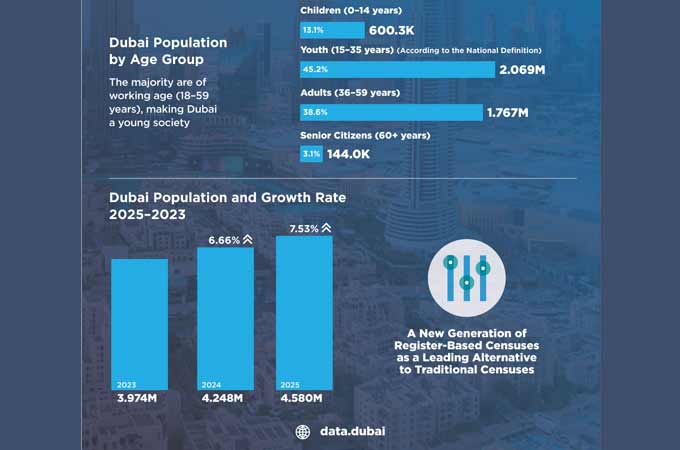
The Emirate of Dubai's population reached 4.580 million by the end of 2025, an increase of approximately 332,000 people compared to the end of 2024, representing a growth of 7.5%, it has been revealed.
These figures are based on an advanced digital methodology that leverages administrative records, smart systems, and real-time data, according to the “Dubai Population Now” Real-Time Population Census and Population Growth Monitoring Initiative.
The initiative of Dubai Digital, through the Dubai Data and Statistics Establishment, was approved by His Highness Sheikh Hamdan bin Mohammed bin Rashid Al Maktoum, Crown Prince of Dubai, Deputy Prime Minister, Minister of Defence, and Chairman of the Executive Council of Dubai.
Hamad Obaid Al Mansoori, Director General of Dubai Digital, said: "The approval of the “Dubai Population Now” Real-Time Population Census and Population Growth Monitoring Initiative marks a new strategic milestone in Dubai's journey towards establishing a global model for a data- and AI-driven digital government. Data is no longer merely a statistical output; it has become national infrastructure and a strategic asset that supports decision-making, enhances planning efficiency, and strengthens the ability to anticipate the future.
"This project embodies Dubai's vision of leveraging advanced technologies to build an integrated digital ecosystem powered by trusted, real-time data. It enables government entities to develop more precise policies, deliver more proactive services, drive more efficient investments, and further strengthen the emirate's readiness to sustain growth across all sectors."
Al Mansoori added: "What we have achieved today is the result of an integrated ecosystem built on seamless collaboration across government entities, digital trust, and sustained investment in data and artificial intelligence. These are the pillars through which Dubai continues to reinforce its position as a city shaping the future and transforming data into economic and developmental value that benefits people, society, and the economy."
Population dynamics reflect economic vitality
Younus Al Nasser, Chief Executive Officer of the Dubai Data and Statistics Establishment, said: “Population Growth Monitoring in Dubai provides a real-time reflection of a broader strategic landscape that embodies the emirate’s dynamism, economic vitality, and sustained momentum across all sectors.
"Within this broader context, the population growth rate reached 7.5%, driven by real GDP growth of 5.4% in 2025 compared to 2024. A similar trend can be observed across key indicators, including tourism, where Dubai welcomed 19.6 million international visitors in 2025, marking a 5.0% increase compared to 2024.
"In this context, population growth is not merely a statistical figure; it reflects the expansion of the labour market, rising demand for services, and continued improvements in well-being and quality of life. These insights support evidence-based policymaking, urban planning, and the development of infrastructure, healthcare, and education services, helping to ensure a balanced approach between economic growth and individual well-being in a rapidly evolving global city.”
Al Nasser added: "Dubai is a city defined by constant movement and vitality, and a global economic hub that attracts millions seeking opportunities to live and work. In 2025, Dubai’s airports handled approximately 96 million passengers, representing a 4.9% increase compared to the previous year. At the same time, the emirate welcomes significant numbers of people arriving from across the UAE and around the world.
Data for 2025 shows that the average number of individuals present in Dubai during peak daytime hours rises significantly to 6.392 million. This figure comprises the resident population, together with more than 1.812 million individuals temporarily present in the emirate, the majority of whom are in Dubai for work or tourism, in addition to students, shoppers, and other short-term visitors.
These insights provide a more comprehensive understanding of the actual population present in the emirate at any given time and support more informed planning, resource allocation, and service delivery, said Al Nasser.
This population dynamism further reinforces Dubai’s position as one of the world’s leading destinations for investment, business, and talent, driven by its advanced investment ecosystem, world-class infrastructure, and policies that foster economic growth and attract skilled professionals.
These population figures are the outcome of the latest enhancements made by the Dubai Data and Statistics Establishment to its methodologies and measurement tools. The Establishment adopts the latest international recommendations and methodologies while harnessing advanced technologies to monitor and derive Dubai’s population through continuously updated real-time data.
Data: The driving force behind AI
The “Dubai Population Now” initiative marks a transformative shift in the way population data is generated and utilised, introducing an advanced register-based approach built on administrative records and smart systems. As part of the project, the Dubai Data and Statistics Establishment has integrated artificial intelligence (AI) into population data analysis and linked it to Dubai’s real-time Population Clock—one of the project’s key innovations. This enables the forecasting of demographic trends, provides deeper insights into mobility and residency patterns, and supports more effective urban planning and public service delivery.
Dubai's population over time
Dubai's population has undergone remarkable growth throughout its history, closely reflecting the emirate's economic and urban development. Historically, population measurement relied on traditional census methods, with seven population censuses conducted between 1975 and 2005. Today, Dubai has transitioned to a real-time population model based on continuously updated data streams.
This transformation represents a significant advancement in understanding population dynamics. Population growth can now be measured in real time, whereas in previous years data was updated at longer intervals, enabling more accurate planning and faster responses to changing demographic trends. At 7.5%, the current population growth rate is among the highest ever recorded in the emirate, recalling major periods of demographic expansion. The highest growth rate in Dubai's history was recorded in the 1980 census, reaching 8.2%.
Looking further back, historical records and documented sources indicate that Dubai's population did not exceed 12,000 residents in 1881. Over the subsequent 144 years, the emirate's population grew nearly 380-fold, surpassing 4.580 million residents by the end of 2025, reflecting an extraordinary demographic transformation and Dubai's emergence as one of the world's leading cities.