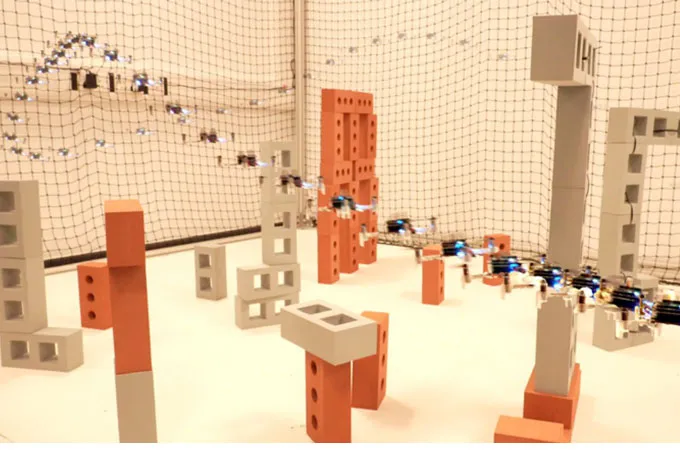
Researchers at Durham University have developed a new drone navigation system that enables autonomous aircraft to fly faster, more smoothly and more safely through crowded and obstacle-filled environments.
This leads to new possibilities for applications such as search and rescue, infrastructure inspection and environmental monitoring.
The new system, called CORTO-Planner, has been designed to help drones make better decisions about where and how to fly in real time. Rather than simply finding the shortest route, it identifies the safest and most efficient path through complex surroundings and continuously adjusts the drone's flight to maintain speed while avoiding obstacles.
Moving quickly through narrow spaces
The research, published in IEEE Robotics and Automation Letters, addresses one of the biggest challenges in autonomous flight: enabling drones to move quickly through narrow spaces without sacrificing safety.
Current drone navigation systems often force drones to slow down sharply when flying near obstacles because they rely on rigid or restrictive safety zones.
Researchers have overcome this problem by developing what they describe as a ‘piecewise parametric safe corridor’ – a flexible safety zone that adapts to the surrounding environment while remaining smooth enough for the drone to fly through at high speed.
The new approach creates flight corridors with up to six times more usable space than previous methods and provides up to 59 per cent wider clearances around obstacles.
Greater freedom
This gives drones much greater freedom to manoeuvre safely, allowing them to maintain faster, smoother flight even in densely cluttered environments.
The researchers also developed a highly efficient computing method that removes the need for slow and complex mathematical calculations that have previously limited this type of technology.
As a result, the system can operate in real time, enabling drones to react quickly to changing environments while maintaining safe distances from obstacles.
The team tested the system extensively in computer simulations and on real drones flying through challenging courses featuring narrow gaps, sharp turns and maze-like layouts.
Across a range of environments, CORTO-Planner consistently achieved faster flight times and higher average speeds than several leading state-of-the-art drone planning systems, while continuing to navigate safely.
Long-standing challenge
Co-author of the study Dr Junyan Hu from Durham University, said: “This work addresses a long-standing challenge in autonomous navigation: how to combine safety, speed and smooth motion in complex environments. We've developed a new way of representing safe flight space that gives drones much greater freedom to manoeuvre while still maintaining reliable obstacle avoidance.”
The research also represents an important scientific advance. Until now, researchers have generally had to choose between flight corridors that accurately represent complex spaces but produce jerky drone movements, or smooth corridors that are too restrictive and force drones to slow down.
The new approach combines the advantages of both, creating flight paths that are smooth, adaptable and suitable for high-speed autonomous navigation.
Beyond improving flight performance, smoother navigation can also reduce unnecessary movements, helping to improve battery efficiency and reduce wear on drone components during long-term operation.
The researchers believe the technology could support future drone operations in search and rescue, forest exploration, industrial inspection, warehouse automation and other situations where aircraft must navigate quickly and safely through difficult environments without human intervention.
The team has made their software openly available to support further research and believes the underlying approach could also benefit other autonomous systems, including self-driving vehicles, robotic arms and underwater robots that must safely navigate confined spaces.—TradeArabia News Service