Insufficient capital is a key obstacle to expanding electricity access for the roughly 600 million people in Africa who currently live without it, according to a new International Energy Agency (IEA) report that outlines essential tools to unlock greater investment and eliminate the access gap.
Financing Electricity
Access in Africa, published today, finds that with progress on expanding
electricity access in Africa stalling, $150 billion in investment is needed to
deliver universal access within the next decade – or about $15 billion per
year.
According to new IEA
tracking, less than $2.5 billion was committed for new electricity access
connections in sub-Saharan Africa in 2023, the most recent year for which full
data are available.
While that is a
quarter more than was committed in 2019, it still lags far behind what would be
required to provide universal access by 2035.
The report finds that
despite a challenging macroeconomic backdrop, mounting pressures on domestic
budgets in African countries, and recent cuts to development aid, universal
access to electricity across sub-Saharan Africa can be achieved within this timeframe
with the right enabling conditions and strong action by governments, the
private sector and development finance institutions.
Based on fresh
analysis, it outlines how this goal could be realised in practice, drawing on
successful strategies that have helped close electricity access gaps in other
regions.
More than 70 per cent
of the investment committed in 2023 came from international public finance,
while the private sector contributed less than 30 per cent.
In a scenario that reaches universal access in
sub-Saharan Africa by 2035, overall investment is much higher, and 45 per cent
of it would need to come from private investment.
To achieve this, the
report recommends a series of targeted regulatory changes, as well as
incorporating electrification strategies into national planning and rural
development programmes.
This would help
increase electricity demand and support sustainable economic development in
rural areas, which in turn would help draw in private funding.
The report also lays
out methods to drive a tenfold increase in equity financing for access
projects, a crucial lever for quickly scaling up investment.
In addition, it sees a
strong role for grants – although it notes that improvements to results-based
financing are needed to maximise their impact.
Concessional finance
resources would account for about 40 per cent of total investment over the next
decade on a pathway to universal access by 2035.
The report calls for
adopting a strategic approach that focuses resources on areas that cannot be
serviced by the private sector.
These include low-income and vulnerable
communities, the early stages of project or company development, and technical
assistance and capacity building.
According to the
report, financing currently skews towards urban areas, even though 80 per cent
of the population without electricity access lives in rural regions.
It is also
geographically concentrated, with half of finance flows channelled to only six
countries.
To tackle these discrepancies, it recommends
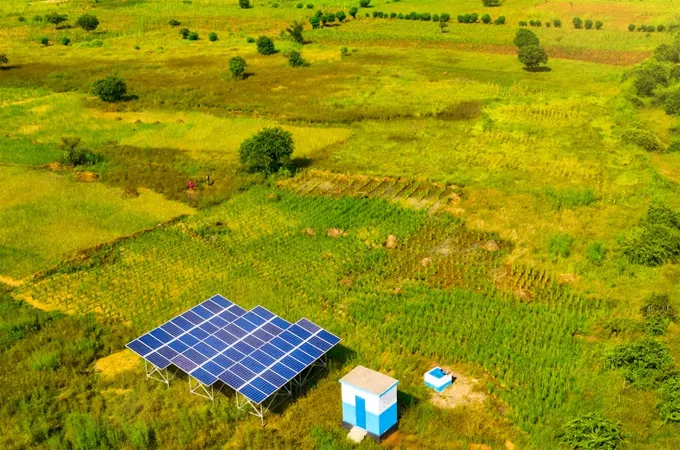
the continued development of new and innovative financing mechanisms that can
help direct investment towards decentralised energy solutions, such as
mini-grids and solar home systems.
Targeted financing
approaches are also needed for communities living in informal settlements,
fragile states and vulnerable humanitarian contexts, which account for a
significant share of the population without access today.
The report also
emphasises that beyond connecting households to electricity, additional finance
of at least $2 billion per year is necessary to ensure that basic levels of
energy service are affordable.
IEA analysis shows
that roughly 220 million people in Africa (or about 40 per cent of those
without access) are unlikely to be able to afford a “basic bundle” of services,
based on today’s income and subsidy levels, while 400 million people would not
be able to afford an “essential bundle”.
To tackle this issue,
concessional capital can be deployed to reduce financing costs and open the
door for more private sector financing, while governments could consider
deploying time-bound subsidies to consumers or developers. -OGN/TradeArabia News Service