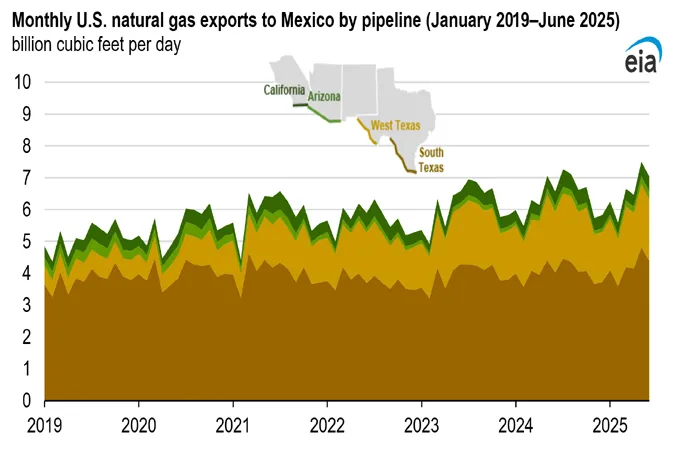
US natural gas pipeline exports to Mexico averaged 7.5 billion cubic feet per day (Bcf/d) in May 2025, the most of any month on record as Mexico’s demand for natural gas, particularly in the electric power sector, increases, according to US Energy Information Administration (EIA) .
On an annual basis,
US natural gas pipeline exports to Mexico averaged 6.4 Bcf/d in 2024, a 25 per
cent increase compared with 2019 and the highest on record in data going back
as early as 1975.
Total consumption
of natural gas in Mexico increased from 7.7 Bcf/d to 8.6 Bcf/d during the
same time period, with most growth concentrated in Mexico’s electric power
sector.
Natural gas exports
from the United States enter Mexico along four main corridors—South Texas, West
Texas, Arizona, and California—with a combined capacity of about 14.8 Bcf/d and
an approximate utilisation rate of 43 per cent in 2024.
Several factors
limit US natural gas exports to Mexico, including:
In 2024, pipeline
exports from West and South Texas collectively accounted for 91 per cent of US
natural gas pipeline exports to Mexico.
The South Texas
corridor connects from the Agua Dulce Hub into northeastern Mexico.
Natural gas from
the Permian Basin in West Texas primarily serves northwestern, central, and
southwestern Mexico through various natural gas systems in Mexico.
Exports from West
Texas increased from 0.6 Bcf/d in 2019 to 1.8 Bcf/d in 2024.
The increase of US
imports was facilitated by the commissioning of additional connecting
pipelines in central and southwestern Mexico in recent years.
Mexico plans to
continue to expand its domestic pipeline network to meet potential growth in
demand.
Natural gas
imported from the South Texas corridor through the Sur de Texas–Tuxpan
pipeline has access to liquefied natural gas (LNG) terminals, power
plants, and other uses of demand, and the pipeline connects with the Gasoducto
Puerta al Sureste (Southeast Gateway Gas pipeline), an offshore pipeline
completed in 2025 and designed to supply natural gas to new power plants in the
Yucatan Peninsula.
In 2022, sections of the Tula–Villa de Reyes
and Tuxpan–Tula pipelines commenced partial operation, with full service
anticipated in 2025.
The Energia
Mayakan pipeline is expected to expand natural gas infrastructure on the
Yucatán Peninsula by 2025.
Developers of
the Centauro del Norte pipeline, which will provide additional
pipeline capacity to northwestern Mexico's combined-cycle power plants, began
construction in 2025.
LNG was first
exported from Mexico in August 2024 from the Fast LNG Altamira Floating
Liquefied Natural Gas (FLNG) 1.
Two additional LNG export projects, Fast LNG Altamira FLNG 2 and Energía Costa Azul, are currently under construction with a combined capacity of 0.6 Bcf/d, drawing supply from US natural gas imports. Supporting pipelines, such as the Sur de Texas–Tuxpan and Gasoducto Rosarito expansion facilitate these LNG export projects. -OGN/TradeArabia News Service