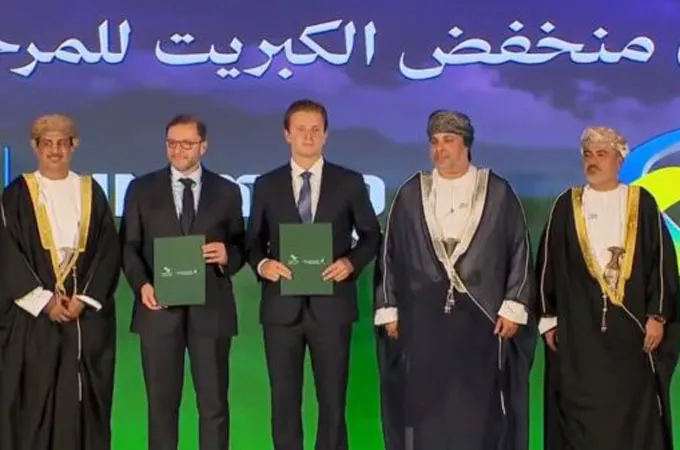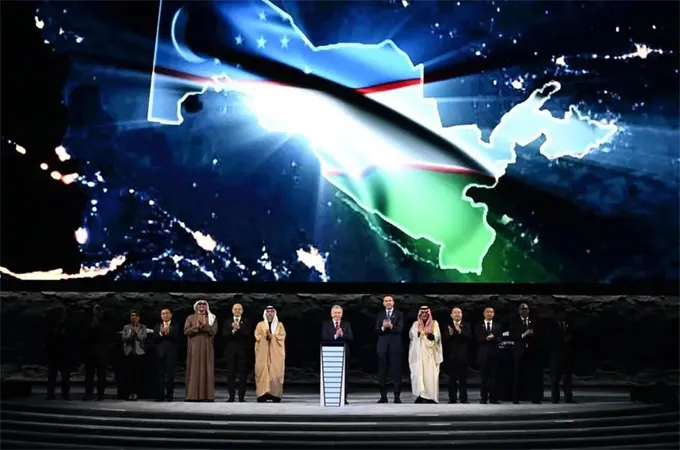
The President of the Republic of Uzbekistan, Shavkat Mirziyoyev, inaugurated the Nur Bukhara project, the country’s first utility-scale integrated solar and battery project, developed by Abu Dhabi Future Energy Company Masdar.
The President also
formally ‘broke ground’ on Masdar’s 300-megawatt (MW) solar photovoltaic (PV)
and 75-megawatt hours (MWh) battery energy storage system (BESS) Guzar project,
during a ceremony in Tashkent.
Jamshid Khodjaev,
Deputy Prime Minister of Uzbekistan, and Suhail Mohamed Al Mazrouei, Minister
of Energy and Infrastructure, also witnessed the exchange of investment,
transmission connection and battery storage system agreements for the Zarafshan
BESS project, the nation’s largest standalone battery project, and a
development roadmap for a 1,000MW wind power project in the Navoiy region,
which will form the first phase of a 2,000MW programme.
Al Mazrouei affirmed
that the UAE is a key partner of the Republic of Uzbekistan in developing the
energy sector in the country, particularly in the field of renewable energy and
strategic projects that support sustainable development.
He pointed out that
cooperation between the two countries has led to delivering transformative
projects that enhance energy security and establish a leading model for the
transition toward clean and reliable energy sources.
He said, “Through
Masdar’s projects, which have become among the fastest-growing in Central Asia
with a capacity exceeding 2,000 megawatts, the UAE continues to support
Uzbekistan’s national efforts to develop a more efficient and sustainable
energy infrastructure, contributing to long-term economic development that
benefits future generations. We are proud to expand our partnership with the
Republic of Uzbekistan, and we remain committed to strengthening it in ways
that serve our mutual interests and advance the progress of clean and renewable
energy.”
Jurabek Mirzamahmudov,
Minister of Energy of Uzbekistan, said, “In recent years, friendly relations
between the heads of state of Uzbekistan and the UAE have reached a new level.
During President Shavkat Mirziyoyev’s visit in January, Uzbek-Emirati relations
were elevated to the level of a strategic partnership. The UAE company Masdar
was the first to establish cooperation in the development of green energy in
Uzbekistan and launched the country’s first solar photovoltaic power plant in
2021.
“In cooperation with
Masdar, five solar power plants with a total capacity of 1,247 MW, one wind
power plant with a capacity of 500 MW, and a 63 MW energy storage system were
successfully commissioned in a short period of time. In addition, construction of
a 300 MW solar photovoltaic power plant has begun. These projects will make a
significant contribution to the integration of large-scale renewable energy
sources into the grid and to the further development of Uzbekistan’s energy
sector.
“Overall, the UAE is a
reliable partner of Uzbekistan in its energy transition, and we are grateful
for this friendly cooperation.”
Mohamed Al Ramahi,
Chief Executive Officer of Masdar, said, “Masdar is proud to be a longstanding
partner in Uzbekistan’s ambitious clean energy journey. The inauguration of Nur
Bakhara represents a key milestone, bringing the benefits of integrated solar
and battery storage at scale for the first time. The Guzar project and the
other agreements signed today will expand our presence in Uzbekistan and
further deepen our collaboration. We thank Shavkat Mirziyoyev and the
Government of Uzbekistan for their continued trust and support.”
The Nur Bukhara 250MW
solar PV and 63MW/126MWh BESS project can produce enough electricity to power
over 55,000 homes while avoiding 367,000 tonnes of carbon dioxide emissions
annually.
The Guzar project,
scheduled to begin operations in 2027, will be capable of powering 60,000 homes
while avoiding over 400,000 tonnes of emissions.
The 300MW/600MWh
Zarafshan BESS project is scheduled to begin operations in 2028 and will be
capable of storing energy equivalent to powering approximately 1.3 million
households for two hours.
A second 300MW/600MWh
phase is also planned for the facility.
These initiatives will
add to Masdar’s growing footprint in Uzbekistan, which includes around 2
gigawatts (GW) of clean energy capacity, with investments exceeding $2 billion.
With abundant wind and
solar resources, Uzbekistan is targeting at least 25GW of renewable energy
capacity, and generating 54 per cent of power from renewables by 2030.
President Mirziyoyev announced the latter goal at Abu Dhabi Sustainability Week
this year.
The CIS region is a
strategic market for Masdar as it targets a global portfolio capacity of 100GW
by 2030. Beyond its footprint in Uzbekistan, the company has an active presence
across Kazakhstan, Kyrgyzstan, Turkmenistan, Azerbaijan and Armenia in the region.
In Uzbekistan and
across its global markets, Masdar’s work is anchored in its ability to deliver
firm, competitively priced clean power; integrating solar, wind and storage
solutions that help relieve grid constraints and provides partners and
customers with the reliable capacity they need as demand rises.
Masdar is also
advancing large-scale energy storage innovation worldwide. In October, it broke
ground on the world’s first gigascale 24/7 solar and battery storage project in
Abu Dhabi, featuring a 5.2GW solar plant integrated with a 19GWh BESS to deliver
1GW baseload renewable power. Upon completion, this will be the largest and
most technologically advanced system of its kind globally. -OGN/TradeArabia News Service