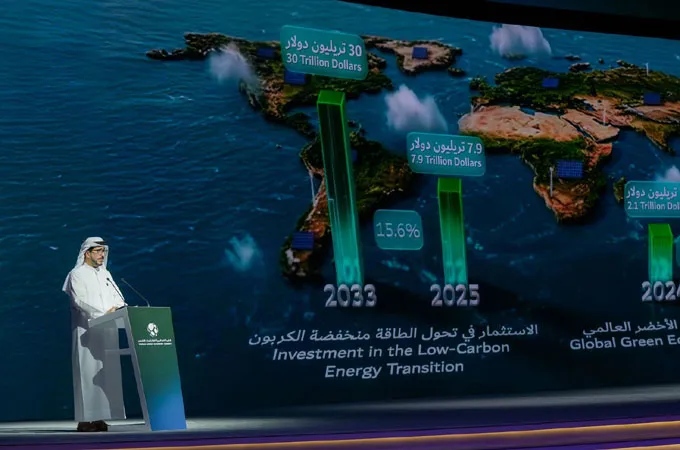
The 18th World Future Energy Summit, part of Abu Dhabi Sustainability Week and hosted by Masdar, opened on January 13 at the ADNEC Centre Abu Dhabi, and saw a number of key discussions around investment, clean energy adoption and cross-border collaborations take shape, with announcements worth billions of US dollars set to take place across the three-day event.
Opening the Summit,
Ditte Jørgensen, Director General of Directorate-General for Energy (DG ENER)
at the European Commission, delivered a keynote speech highlighting Europe’s
commitment to hydrogen as a critical component in its energy transition, reported WAM.
Emphasising the EU’s
role in decarbonisation, she said the legal framework established to support
global and low-carbon hydrogen production means there are significant
opportunities within the GCC.
The Connecting Europe
Facility (CEF) for Energy, the EU funding programme to implement the
Trans-European Networks for Energy policy, will increase fivefold to eventually
reach €30 billion ($35 billion), she said. As negotiations with Gulf
Cooperative Council countries proceed, Jørgensen called the opportunity to
collaborate “essential for both sides”.
“A stable and
ambitious trade and investment framework between the European Union and
countries in the GCC will unlock further private investment, including in
energy-critical raw materials, which are key to building the supply chains of
the future, green technologies, and help bring innovation, affordability,
competitiveness, and security,” Jørgensen added.
On the same stage,
Lucie Berger, the ambassador for the EU Delegation to the UAE, revealed the
Emirates is the EU’s leading investment partner, with mutual investments
reaching approximately €328 billion ($383bn). Emphasising the potential
benefits, she said future strategic partnership agreements with individual Gulf
states and free trade agreements would “unlock even greater shared gains in the
energy sector, focusing on renewable energy, hydrogen, and cleantech”.
Organised in
partnership with the EU-GCC Cooperation on Green Transition Project, Mohammad
Abdelqader El-Ramahi, Chief Hydrogen Officer at Abu Dhabi’s Masdar, also took
to the stage, telling delegates he believes mutual investments between the UAE
and EU could, in time, reach trillions given international banks have projected
global investment in green hydrogen alone to exceed US$11 trillion by the year
2040.
Trevor Ducharme,
President at Global CMX, is attending this week’s Summit and took part in a
fireside chat with journalist and broadcaster Richard Dean to discuss a
groundbreaking UAE-Australia economic energy partnership. Speaking during his
session, Ducharme referred to the Comprehensive Economic Partnership Agreement
(CEPA) between the two countries as “a game-changer for the UAE-Australia
energy corridor, creating fertile ground for multi-billion-dollar investments
that will redefine sustainable development.” As the CEPA was only ratified in
November 2025, the World Future Energy Summit is the first global event where
the industry can engage directly with the partnership stakeholders.
“The UAE-Australia
CEPA is a catalyst to unlock billions in renewable energy deals, and it is
starting at World Future Energy Summit 2026,” added Ducharme.
Engineer Ahmed Al
Falasi, Energy Efficiency Sector Executive Director at Abu Dhabi Department of
Energy, opened the embedded Clean Energy Conference with a keynote highlighting
the importance of integrated system design to accelerate the energy transition
while safeguarding reliability and energy security.
“Abu Dhabi’s clean
energy journey has taught us that the energy transition does not succeed
because of a single technology, but when entire systems are designed to work
together,” he said. “Today, solar is no longer an emerging option – it is
infrastructure, and we have moved decisively from pilot projects to
utility-scale deployment. As solar and storage expand, the real test is
reliability when the sun is not shining – and this is where system design
becomes critical.
“Solar provides scale
and cost efficiency, storage provides flexibility, and nuclear provides clean,
stable baseload power. Hydrogen further strengthens dispatchable low-carbon
options. Together, these technologies form a balanced load system that supports
economic growth while maintaining energy security. Digital transformation must
sit at the centre of this evolution. AI-enabled platforms that integrate
electricity, water, cooling, and operational data into a single trusted view
can shift us from reactive management to predictive decision-making – improving
forecasting, optimising dispatch, and identifying inefficiencies before they
become system risks.”
On the Pathway to
1.5°C stage, senior representatives from finance, academia, and sustainability
discussed nature-based outcomes and their business implications. Omar Shaikh,
Managing Director at the Global Ethical Finance Initiative, warned that ecosystem
degradation and biodiversity loss now pose real risks to global economies and
supply chains. He underscored the scale of the challenge, noting that
“according to the World Economic Forum, nearly 50 per cent of global GDP relies
on nature and biodiversity, yet we do not value this on our financial
statements or our balance sheets and often take it for granted.”
Shaikh also
highlighted the complexity of making nature investable, drawing on work with
UNDP to examine how nature, biodiversity, and sustainable agriculture can be
structured as viable asset classes capable of attracting private sector
capital. With 90 per cent of the UAE’s population and critical infrastructure
concentrated on the coastline alongside mangroves, coral reefs, and seagrass,
Professor John Burt, Head of Environmental Studies at NYUAD, later argued these
ecosystems must be viewed as national infrastructure, emphasising their
economic value and vulnerability.
Gulf cities should
‘create something new’ rather than try to replicate New York or London
During a panel
discussion held as part of a two-day Sustainable Cities and EMobility
Conference, Ellora-Julie Parekh, Chief Sustainability Officer at Al-Futtaim,
noted a recent company whitepaper found 33 per cent of UAE residents use public
transport due to accessibility issues as she advocated for an integrated
mobility approach. Marina Antonopoulou, Chief Climate and Conservation Officer
at Emirates Nature WWF, meanwhile stressed the importance of green corridors
and biodiversity initiatives for climate adaptation and human well-being.
While previous
centuries saw New York and London resist the temptation to develop on huge
plots of urban land, retaining sprawling green spaces at Central Park and Hyde
Park, Antonopoulou says the climate in the GCC demands something different.
“The region now has a chance to do something similar, but that looks different.
We have a chance to define what that equivalent is. The workout Abu Dhabi is
doing with mangroves is fantastic, so maybe that's a piece of the answer, while
Dubai is on the migratory route for a number of birds so maybe that's another
option. It's not a single bullet; it's not copying something that is nice –
it's an opportunity for us to create something new.”
As part of the IRENA
Innovation Day, a panel discussion titled ‘Renewable Integration for
Competitive Industries’ discussed the expansion of renewable energy projects in
Oman, Saudi Arabia, and Morocco, focusing on methanol production from wind and
solar energy. By 2030, the goal is to achieve cost parity with fossil fuels.
The panel also addressed the strategic importance of corporate Power Purchase
Agreements (PPAs) in enabling the growth of renewable energy for industrial
sectors. Marina Sergeeva, Senior Consultant Corporate PPA and Green Energy
Procurement, DNV, emphasised that PPAs typically last 12–15 years and that
shortening their duration can reduce price competitiveness for industrial
customers.
“Longer-term PPAs,
conversely, improve bankability for project developers and attract large,
financially robust industrial partners such as those in mining and cement,”
said Sergeeva. “These agreements ensure a stable revenue stream and support
greater investment confidence from both energy suppliers and financiers. The
profitability and financial security that PPAs offer are essential to scaling
renewable energy projects and providing the industry with affordable, reliable
green electricity.”
“We are absolutely thrilled with the Summit’s opening day across all our major metrics,” said Gareth Rapley, Portfolio Director - Energy and Marine at RX Global. “We’ve seen fantastic footfall across nine show halls, packed conference sessions tackling some of the industry’s most pressing challenges, and high-levels of industry-wide collaborations – in the form of exciting investment announcements and fledgling collaborations – being finalised and explored by like-minded businesses from every corner of the world. The World Future Energy Summit continues to connect the international renewable energy ecosystem in Abu Dhabi, while also propelling the emirate’s standing as a respected global connector and enabler.”