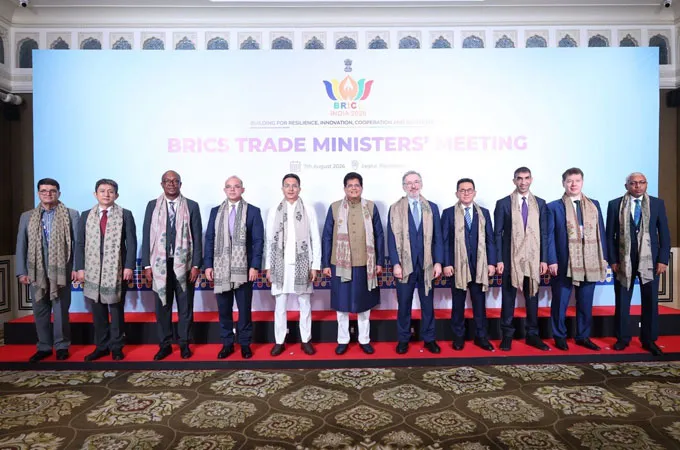
Trade ministers from the BRICS (Brazil, Russia, India, China, South Africa) group attended the 2026 BRICS Trade Ministers Meeting in Jaipur hosted by India under its BRICS presidency, to discuss ways to strengthen the multilateral trading system, improving trade resilience and market connectivity as well as supporting small and medium-sized enterprises (SMEs) amid growing challenges to global commerce owing to Strait of Hormuz shutdown.
A powerful global economic bloc, BRICS expanded from five founding members to nine countries in 2024, with Indonesia joining in 2025, bringing membership to 10. The group now includes Indonesia, Ethiopia, Egypt, Iran and the UAE.
The emirates' participation forms part of its broader trade strategy, including its Comprehensive Economic Partnership Agreement programme, which aims to increase non-oil foreign trade to $1.1 trillion by 2031. Since its launch in 2021, the UAE has concluded 38 CEPA agreements, with 18 currently in force.
UAE Foreign Trade Minister Dr Thani bin Ahmed Al Zeyoudi, at the meeting, called for the immediate and unconditional reopening of the Strait of Hormuz voicing concern over attacks on commercial shipping and disruptions to international trade.
India remained one of the UAE's largest trading partners, with bilateral non-oil trade rising 17.3% to $76.2 billion in 2025.
Al Zeyoudi and India's Commerce and Industry Minister Piyush Goyal reviewed progress under the India-UAE Comprehensive Economic Partnership Agreement and discussed cooperation in services, digital commerce, logistics and food security. Al Zeyoudi was joined by Abdulla Al Nuaimi, UAE Ambassador to India.
The bilateral meeting with Goyal provided an opportunity to review progress under the India-UAE CEPA, which entered into force in May 2022, and to discuss avenues for expanding cooperation in services trade, digital commerce, logistics, and food security.
Both sides reaffirmed their commitment to advancing trade facilitation and strengthening private-sector collaboration in high-growth sectors.
Al Zeyoudi later held a series of bilateral discussions with key counterparts, including Li Chenggang, China International Trade Representative and Vice Minister of Commerce; Dr Mohamed Farid Saleh, Minister of Investment and Foreign Trade of Egypt; Dr Budi Santoso, Minister of Trade in Indonesia; Parks Franklyn Mpho Tau, Minister of Trade, Industry and Competition of South Africa; and Ilichev Vladimir Evgenievich, Deputy Minister of Economic Development of Russia.
The discussions focused on strengthening bilateral trade and investment ties, expanding cooperation in priority sectors, and greater private-sector engagement.
Al Zeyoudi said: "At a time of heightened uncertainty in global trade, co-operation between emerging markets and developing economies is more important than ever. The UAE views BRICS as an important platform for strengthening economic co-operation and supporting an open and predictable trading environment."
"Our engagement in Jaipur reinforced the strength of the UAE’s economic relationships with fellow BRICS members, and we are committed to translating these discussions into tangible outcomes for businesses and communities," he stated.
Non-oil trade between the UAE and BRICS members rose 28.5% in 2025 to more than $312 billion, from $243 billion a year earlier, according to UAE government data.
BRICS countries accounted for about 31% of the UAE's total non-oil foreign trade last year.
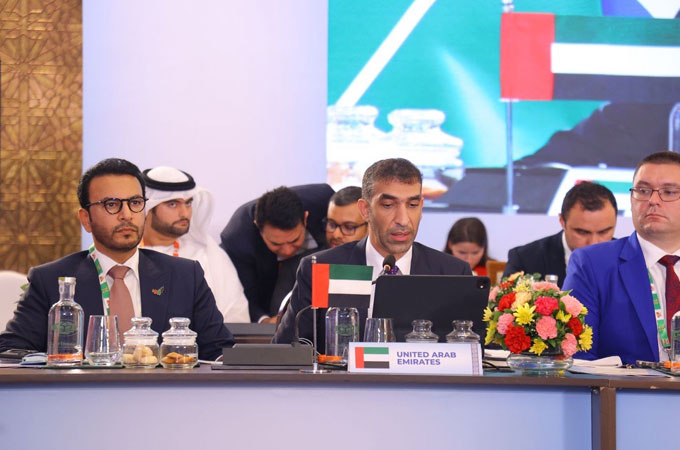
In his remarks, Al Zeyoudi said cooperation among emerging and developing economies was increasingly important amid uncertainty in global trade, adding that the UAE viewed BRICS as a platform for strengthening economic ties and supporting an open and predictable trading environment.
"Our membership reflects our commitment to expanding economic ties with partners across the developing world and advancing open, mutually beneficial trade," he added.
The UAE’s participation in the BRICS TMM complements its broader trade agenda, anchored by the Comprehensive Economic Partnership Agreement (CEPA) programme, which aims to increase non-oil foreign trade to $1.1 trillion by 2031.
Since its launch in September 2021, 38 agreements have been concluded with economies across Asia, Africa, Europe, and the Americas, with 18 in force – including agreements with fellow BRICS members India and Indonesia.-TradeArabia News Service