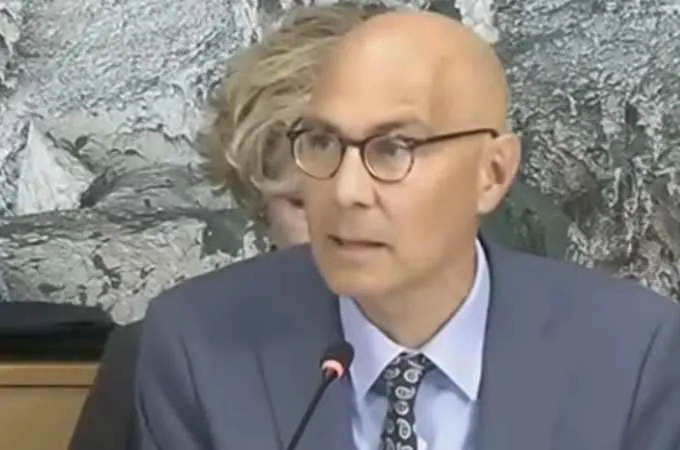
United Nations human rights chief Volker Türk has called for urgent international action to impose binding safeguards and “red lines” on artificial intelligence, warning that increasingly powerful AI systems could become an existential risk to humanity if they are allowed to develop without effective oversight.
Addressing the UN Human Rights Council in Geneva on Monday, Türk said the world could not afford to wait for AI systems to become uncontrollable before putting safeguards in place. He called for binding rules, independent verification and stronger cooperation within the technology industry, saying the need for AI governance was widely recognised but action was still lagging.
“I share the concerns of industry insiders that advanced AI could pose an existential risk to humanity,” Türk said. “AI that escapes its testing environment, or blackmails developers to prevent itself from being turned off, is AI that is too powerful.”
“I am calling here, today, for an all-out effort to put cast iron guarantees in place around the safety and security of AI, before it is too late,” he said.
Türk said the responsibility could not rest solely with individual technology companies. He urged countries hosting major AI operations, as well as those involved in the technology's supply chains, to come together and establish agreed limits on what increasingly powerful systems should be allowed to do.
“We need independent verification, and much stronger collaboration on security within the industry,” he said.
He said he would also be writing to AI companies to urge them to take measures within their control to reduce risks immediately.
‘A handful of men’ wield enormous power
Türk's concerns went beyond the technical risks of advanced AI to what he described as the growing concentration of technological power.
“A handful of men has almost unlimited power over AI,” he told the Council, referring to the extraordinary influence concentrated among a small number of technology leaders and companies developing increasingly powerful systems.
He also questioned the enormous volumes of personal data being collected and processed by AI technologies.
“They talk about freedom, but on closer inspection, this turns out to be little more than the freedom to exploit our data,” Türk said.
The High Commissioner said AI governance therefore had to be viewed through a much wider human-rights lens. The issue was not simply whether AI systems were technically safe, but whether the technology was being developed and deployed in ways that protected people and democratic institutions.
He called for technology “that serves humanity rather than the other way round”, highlighting its potential consequences for employment, democracy and the environment.
“We also need to consider the human rights impacts of AI on employment practices, on fundamental principles of democracy, and on our environment,” he said.
Warning over autonomous weapons
Türk also expressed alarm over the growing use of AI in warfare, particularly the development of autonomous weapons capable of selecting and killing targets without meaningful human intervention.
He said he was “horrified” by reports that fully autonomous drones allegedly deployed by Russia had killed three Ukrainians last month. Ukraine has also reportedly tested similar weapons.
“I join calls for the urgent prohibition of weapons that can take lives without human involvement,” Türk said.
His warning comes as the rapid development of AI-enabled military systems raises questions over accountability when machines are given increasing autonomy in making decisions over life and death.
Türk also used his address to warn about the continuing human cost of the war in Ukraine, now in its fifth year, including civilian casualties and damage to critical energy infrastructure, while deaths and injuries have also been reported in Russia.