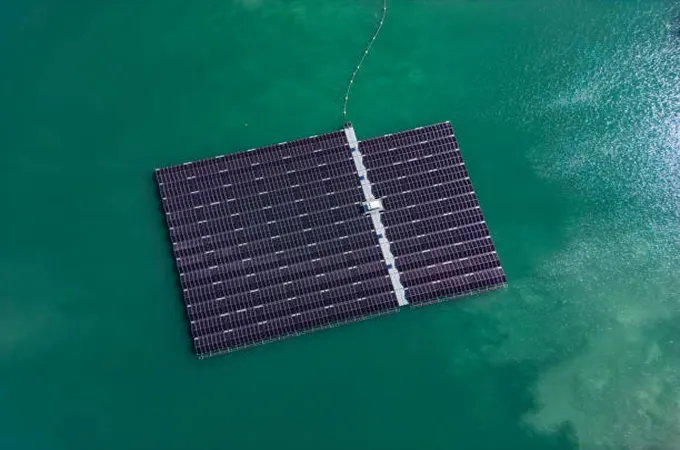
Researchers have tested solar panels at depths of up to 10 metres underwater, potentially opening the way for longer-lasting power supplies for subsea equipment without relying solely on batteries.
The panels were
designed to capture blue and green wavelengths of sunlight that penetrate
seawater more effectively.
During a two-hour
trial near China’s Weizhou Islands, the technology generated 324
milliwatt-hours of electricity at a depth of 10 metres.
The research,
published in Joule, builds on earlier studies conducted at depths of two metres
or less.
The researchers used
perovskite solar cells, which can be tailored to absorb specific wavelengths
and are an alternative to conventional silicon cells.
Laboratory tests
showed the cells converted about 35% of available sunlight into electricity
under conditions replicating 10-metre depths.
Based on testing, the
researchers estimate the panels could operate continuously underwater for
around 5.5 years, potentially supporting subsea sensors, monitoring systems and
other equipment. -OGN/TradeArabia News Service