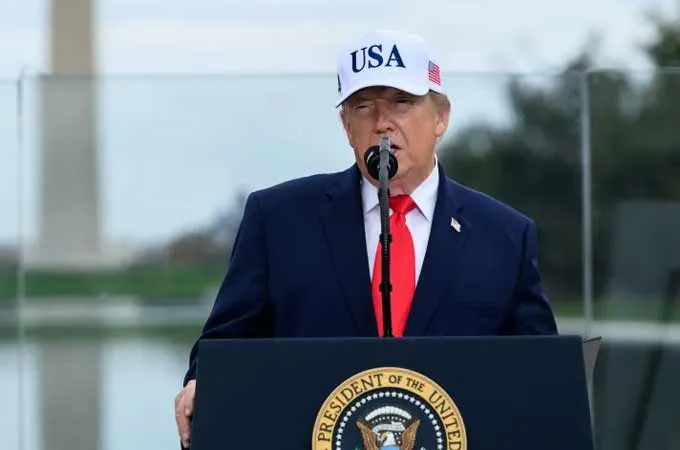
US President Donald Trump is facing mounting political pressure to find a way out of the eight-month war with Iran after a sweeping Republican defeat in the midterm elections, raising the prospect that Washington may favour negotiations over a renewed large-scale military campaign.
The election setback, which handed Democrats control of both chambers of Congress, has weakened Trump's political position and could complicate his ability to sustain military operations against Iran. It has also intensified divisions within his administration over whether to pursue a diplomatic settlement, maintain economic pressure or resume air strikes.
With a Democratic-controlled Congress increasingly capable of scrutinising and constraining his military options, Trump had greater incentive to seek an agreement with Tehran, according to analysts.
A full-scale assault on Iran now appeared less likely, they said, although further limited strikes, potentially targeting nuclear facilities, could provide Washington with a way to claim that its military objectives had been achieved and bring the conflict to an end.
Such an outcome, however, is far from assured. An agreement that allows Tehran to portray itself as victorious while leaving Trump politically weakened could provoke further confrontation rather than deliver lasting restraint, Gulf analysts have warned.
The uncertainty has been reflected in Trump's own statements. In separate interviews this week, he alternated between suggesting that he was considering striking Iran hard and saying there were no immediate plans for a major escalation.
The president's room for manoeuvre has also narrowed following the Republican losses, with the Iran war emerging as a major factor in the party's electoral setback.
Iran war blamed for defeat
Trump acknowledged in an interview with Fox News that the conflict had contributed to the defeat, particularly through its impact on fuel prices and the cost of living.
Vice President JD Vance was considerably more direct, attributing the Republican defeat to the war in a X post on Wednesday.
"The reason we lost is the war," Vance wrote, arguing that the administration needed to acknowledge the political consequences of the conflict before deciding its next course.
He also pointed to voters' concerns over inflation, the administration's foreign policy priorities and its relationship with Israel, suggesting that many who supported Trump in 2024 had switched their allegiance to Democrats.
Trump, while accepting that the conflict had hurt his party electorally, continued to defend his decision to launch military operations, saying he would have made the same decision again.
Democrats prepare to challenge Trump's war powers
The election results have introduced a significant new political constraint on Trump's handling of the conflict.
Democrats will take control of the House of Representatives and Senate when the new Congress convenes in January, giving them greater powers to scrutinise military operations, control spending and challenge the administration's foreign policy decisions.
In Tehran, the Republican defeat has been portrayed as evidence of growing American opposition to the war.
Iran has spent months targeting the region's economic lifelines and disrupting energy supplies and shipping in an effort to increase the economic cost of the conflict for Washington and its allies.
The disruption to the Strait of Hormuz, through which a substantial share of global oil and gas shipments normally passes, has contributed to higher energy costs and uncertainty in international markets.
Iranian parliamentary speaker Mohammad Bagher Ghalibaf, who has been involved in negotiations with Washington, welcomed the Republican losses, suggesting that the American public had delivered a verdict on the war.
Qatar, China step up diplomatic efforts
Against this backdrop, diplomatic efforts have gathered momentum, with Qatar playing a central role in trying to bring Washington and Tehran back to negotiations.
Talks that had stalled over the summer have resumed through intermediaries, with Iranian officials travelling to Doha and Qatari representatives shuttling between Tehran and Washington.
Iranian Foreign Minister Abbas Araghchi said diplomatic exchanges had become intensive, with Qatar and Pakistan playing active roles in the mediation effort.
A draft agreement circulated by Qatari mediators proposes a series of confidence-building measures over three days aimed at restarting direct US-Iran negotiations, according to regional sources cited by Axios.
Qatar has indicated that both sides remain committed to the negotiating process and that proposals are continuing to be exchanged. China has also stepped up its diplomatic engagement, pressing for a political settlement and the resumption of direct negotiations.
Beijing has a significant interest in preventing further disruption to Gulf energy supplies and international shipping. Chinese officials have held consultations with Iranian and Gulf representatives as part of wider efforts to reduce regional tensions.