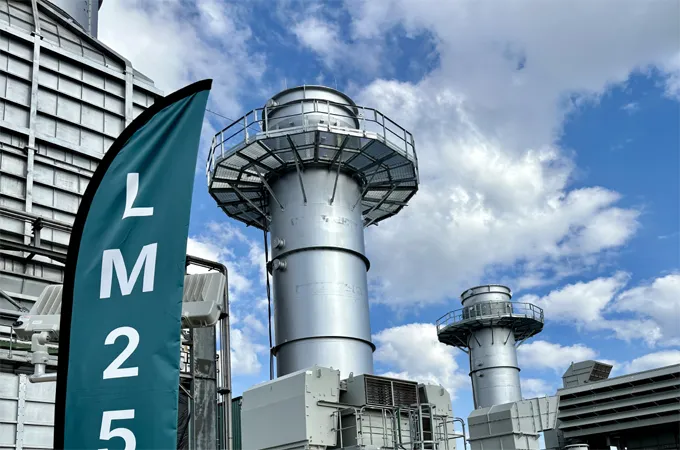
GE Vernova has announced two significant advances in hydrogen-ready aeroderivative gas turbine technology, validating its LM2500XPRESS package for operation with fuel blends containing up to 50% hydrogen and completing testing to demonstrate the 100% hydrogen capability of its LM6000 platform.
The milestones were
achieved at the company's dedicated hydrogen testing facility at its Global Technology
Center in Greenville, South Carolina, and announced during its engagements at
COP31 in Antalya.
The latest
developments strengthen GE Vernova's efforts to advance lower-carbon power
generation while maintaining the flexibility and reliability required by
electricity grids, industrial operators and data centres.
The company has also
surpassed 11 million operating hours using hydrogen and hydrogen-blended fuels
across its global gas turbine fleet. More than 120 GE Vernova gas turbines have
operated or continue to operate on fuels containing hydrogen, demonstrating the
technology's operational experience across different applications.
Cecilia Giovannelli,
CEO of GE Vernova's Gas Power Aeroderivative gas turbine business, said: “These
milestones represent a crucial step in GE Vernova’s commitment to accelerating
the energy transition by providing hydrogen-ready solutions that allow customers
to lower carbon emissions while maintaining the rapid-start reliability
essential for grid stabilization” said Cecilia Giovannelli, CEO of GE Vernova's
Gas Power Aeroderivative gas turbine business. “By rigorously testing these
solutions under real-world conditions and beyond, we are doing more than
solving today’s technical challenges; we are engineering more sustainable
infrastructure to power modern life in the future. Our mission is to deliver
the affordable, reliable energy that communities depend on to thrive, ensuring
that health and economic prosperity grow in lockstep with our decarbonization
goals."
LM2500XPRESS
validates 50% hydrogen blending
The LM2500XPRESS
aeroderivative gas turbine package has been validated to operate with fuel
blends containing up to 50% hydrogen in a Dry Low Emission (DLE) configuration.
Derived from aviation
technology, the modular LM2500XPRESS is designed to provide flexible power
generation and can reach full power in five minutes or less. Its rapid-start
capabilities make it suitable for applications requiring responsive electricity
supply, including industrial cogeneration, district heating, data centres and
grid support.
The platform has
recorded more than 1,150 units sold and over 200 million operating hours,
making it one of the most widely deployed aeroderivative gas turbines globally.
The hydrogen
validation provides operators with an opportunity to introduce hydrogen
blending into existing or new power generation infrastructure while retaining
the turbine's rapid-start performance.
According to GE
Vernova, hydrogen-ready gas turbines can help industrial operators reduce
carbon emissions while maintaining operational flexibility as lower-carbon
fuels become increasingly available.
LM6000 completes
100% hydrogen testing
In a separate
development, GE Vernova successfully completed testing of its LM6000
aeroderivative gas turbine package using a Single Annular Combustor (SAC)
configuration to validate its ability to operate on 100% hydrogen.
The achievement
follows engineering and testing work addressing the technical challenges
associated with hydrogen combustion, including maintaining stable and reliable
turbine operation.
The LM6000 platform
has an installed and shipped base of nearly 1,350 units operating across
approximately 60 countries.
Hydrogen combustion
presents specific engineering challenges because of the fuel's combustion
characteristics. GE Vernova's testing programme aims to demonstrate the ability
of its turbine platforms to operate reliably with increasing hydrogen
concentrations.
The company's hydrogen
combustion technology also enables existing gas turbines to be modified to
operate on different hydrogen concentrations, potentially reaching
approximately 100% hydrogen by volume through appropriate system upgrades.
Expanded testing
capabilities in the US
The completion of the
dedicated aeroderivative testing facility in Greenville represents another
milestone in GE Vernova's investment in its US manufacturing and technology
capabilities.
The facility forms
part of a broader investment programme announced in 2025 and is designed to
support the development and validation of advanced turbine technologies,
including hydrogen-ready power generation solutions.
The integrated testing
centre will allow the company to accelerate product development, reduce testing
and development lead times and strengthen technical support for customers
worldwide.
The facility also
expands GE Vernova's ability to test improved turbine capabilities under
controlled conditions before deploying technologies commercially.
Extending hydrogen
technology across gas turbine portfolio
Beyond its
aeroderivative products, GE Vernova is also advancing hydrogen combustion
capabilities across its heavy-duty gas turbine portfolio.
Its current HA-class
gas turbines, including the 7HA and 9HA platforms, can operate using fuel
blends containing up to 50% hydrogen by volume mixed with natural gas through
the standard DLN2.6e combustion system.
The company's H-class
technology has an established presence across the Gulf Cooperation Council
(GCC), with installations in Saudi Arabia, the UAE and Bahrain.
GE Vernova has also
conducted hydrogen blending deployments and testing at several international
facilities, including DeBary and NYPA Brentwood in the US, Tallawarra B in
Australia and Guangdong Huizhou in China.
Supporting flexible
and lower-carbon power generation
Hydrogen-ready gas
turbines are expected to play a role in supporting the transition towards
lower-carbon energy systems, particularly in sectors where continuous and
reliable power generation remains essential.
Once produced, hydrogen
can be used as a fuel for electricity generation and industrial applications,
including steelmaking, refining and petrochemicals.
Aeroderivative
turbines are particularly suited to applications requiring rapid-start
generation, helping utilities and industrial operators respond to fluctuations
in electricity demand, stabilise grids and manage peak consumption.
For data centres and
other energy-intensive operations, these capabilities provide additional
flexibility as electricity requirements increase.
By enabling turbines
to operate on conventional fuels today while preparing for higher hydrogen
concentrations in the future, GE Vernova aims to offer customers a pathway
towards reducing emissions without compromising power reliability.
The latest testing milestones reinforce the company's strategy of expanding hydrogen combustion capabilities across its gas turbine portfolio while supporting the development of more flexible and lower-carbon energy infrastructure. -OGN/TradeArabia News Service