Despite widespread recognition that AI will reshape the way organisations operate, most enterprises are yet to prepare their workplaces for the change, says a new study.
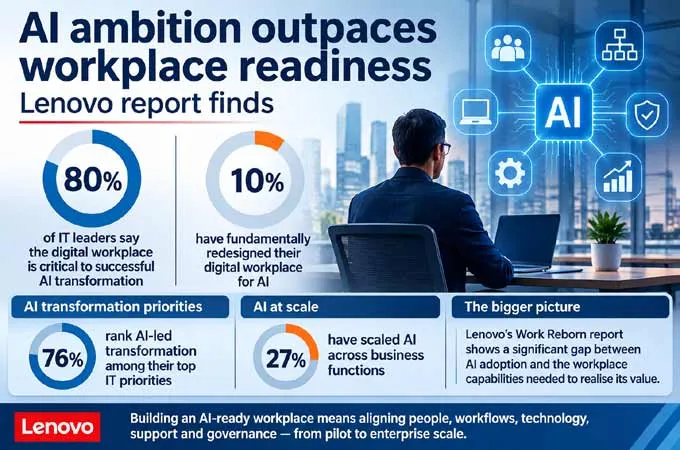
Only one in 10 IT decision-makers say their organisations have fundamentally redesigned the digital workplace for AI, even as eight in 10 consider it critical to successful AI-led transformation, according to Lenovo’s sixth Work Reborn report, The AI-ready workplace.
The findings highlight a growing disconnect between AI adoption and the ability to embed the technology into everyday business operations.
Based on an August 2026 survey of 1,200 IT leaders at organisations with at least 1,000 employees across 12 countries, the report examines what it takes to build an AI-ready workplace. While 76% rank AI-led transformation among their organisation’s top IT priorities, only 27% have scaled AI across business functions.
AI deployment is not same as workplace redesign
Fundamental workplace redesign goes far beyond AI tool adoption. It requires changes across workflows, employee roles, IT support and governance so people and AI agents can work effectively together to deliver transformational impact. The report argues that when AI remains confined to individual functions, its value remains trapped in silos, limiting organisations' ability to translate AI investment into measurable returns across the enterprise.
Lenovo’s expertise comes from years of working inside enterprise customer environments, providing a clear view of how AI initiatives affect day-to-day operations. Lenovo’s Digital Workplace Solutions (DWS) helps organizations take an integrated approach to AI workplace readiness, bringing together devices, digital employee experience, support and services, security and governance around the results they expect AI to deliver.
The AI Workplace Readiness Index benchmarks how prepared organisations are for AI-led transformation across five dimensions: Architecture, Operations, Trust, Workforce and Value, each scored on a 1–5 scale. Organisations with AI embedded across core business functions average 4.1 out of 5 on the Index, compared with 2.7 among organizations still evaluating AI opportunities. The results clearly show a direct correlation between digital workplace readiness and AI progress, demonstrating its critical importance to any strategy for successful scaling AI across the enterprise.
Continuous measurement shows where AI creates value
The AI-ready workplace distinguishes measuring AI’s broader business impact from continuously connecting AI use to workflow outcomes and using that evidence to guide investment. Only one in ten organizations reports the latter, more mature capability. Cycle time, repeat incidents and outcome quality can help leaders determine whether an end-to-end process is improving. Rather than relying on individual productivity measures alone, tracking workflow-level KPIs offer a much stronger basis for deciding which AI use cases to expand, revise or stop altogether.
“Every company we’re talking to is asking the same thing: what value are we actually getting from AI? That’s where workflow-level measurement matters. Are cycle times down? Are repeat incidents falling? Is the outcome better? That’s how you show where AI is creating value,” said Rakshit Ghura, Vice President and General Manager, Lenovo Digital Workplace Solutions.
Human-agent work requires clear roles
The study shows that while 70% of organisations have an AI adoption programme, only 12% measure adoption and effectiveness at individual or team level and use the findings to refine training, employee personas and technology decisions.
The same gap appears in role design. Organisations are exploring how AI agents could change responsibilities more often than formalizing human-plus-agent workforce models. The report recommends defining which routine tasks agents can perform and where human judgment, creativity, accountability and oversight remain essential.
Readiness also depends on where AI workloads run, whether IT support can anticipate and prevent problems, and how AI tools, agents and data are governed. These are connected elements of the workplace operating model, not separate modernization projects.
Rather than prescribe a single sequence, the report recommends assessing all five readiness dimensions and prioritising the gaps most likely to hold back immediate AI objectives. For IT leaders, the goal is to connect workplace changes to the outcomes they expect AI to deliver.
“AI cannot deliver its full value in a workplace designed for the pre-AI era. The opportunity is to redesign how people and AI work together, with the technology, support and governance around them built for how work is changing,” concluded Ghura. - TradeArabia News Service