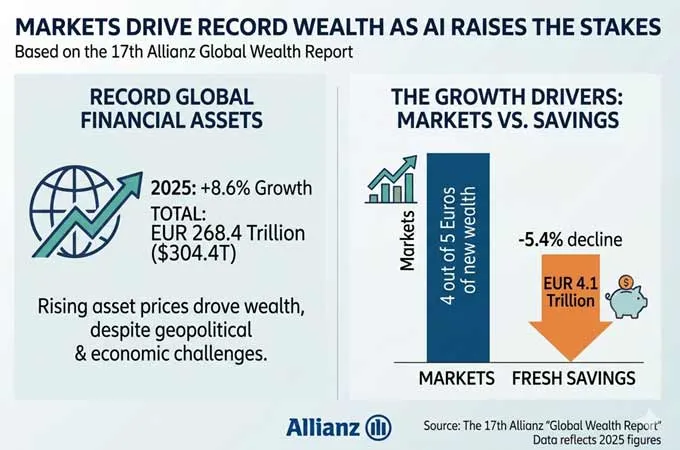
Global financial assets increased by 8.6% in 2025 to a record EUR268.4 trillion ($304.4 trillion), despite a challenging geopolitical and economic backdrop, says a new report.
Markets did the heavy lifting in 2025, as rising asset prices accounted for roughly 4 out of every 5 euros of new household wealth. Fresh savings fell 5.4% to EUR4.1 trillion, said the The 17th edition of the Allianz "Global Wealth Report," which puts the asset and debt situation of households in almost 60 countries under the microscope.
"Global wealth set another record in 2025, but that only tells half of the story," said Ludovic Subran, Chief Economist and Chief Investment Officer at Allianz. "Since 2019, nominal financial assets are up 50%, but in real terms, stripped of inflation, they only grew 23%. The situation is worse in Western Europe where financial assets in real terms are up 0.5% compared to 2019. It is 21% in North America and 70% in China."
Portfolios set the tone
Portfolio composition increasingly determines who captures the gains from wealth creation. Securities increased by 12.4% in 2025, more than twice as fast as deposits (5.7%) or insurance and pensions (5.0%), pushing their share of global financial assets to a record 46.9%.
North American households, with 60.7% of their portfolios invested in securities, benefited particularly strongly from rising markets; their region generated 51.4% of the global increase in financial assets. Over the past decade, valuation gains accounted for 71% of North American financial-asset growth, compared with only 36% in Western Europe, reflecting the importance of investing savings over holding them in low-earning accounts.
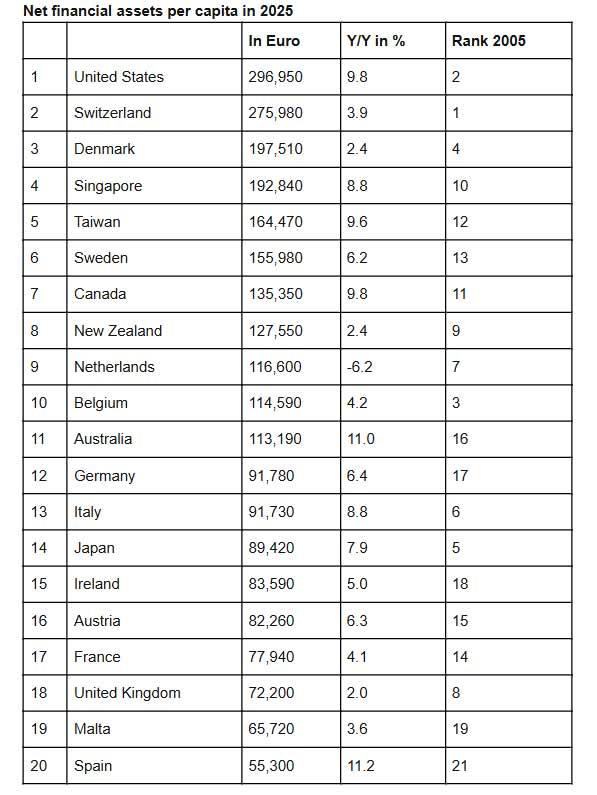
AI as a swing factor amid slowing GDP growth
The report estimates that global financial assets could grow by a solid 9% in 2026, but the medium-term backdrop is turning tougher as slower growth, persistent inflation, fragmentation and high public debt weigh on returns.
Going forward, AI is therefore the key swing factor: stronger productivity and earnings could sustain asset returns, but the growing reliance on AI-powered markets to drive household wealth also creates vulnerability. With the S&P 500 up around 95% since end-2022, much of the recent wealth boost rests on elevated market valuations and AI expectations.
The report found that a 25% correction in the S&P 500 would erase around $27 trillion of US household wealth in the year of the shock, equivalent to almost 14% of total net worth, weighing on confidence and consumption, and pushing the US economy into recession.
But the AI wealth story is not only about how much wealth is created, it is also about who captures the gains.
"AI could become the next great wealth engine, but the key question is who gets a stake in it," said Katharina Utermöhl, Head of Thematic & Policy Research at Allianz Research. "As AI potentially shifts more value creation towards capital, broader participation in capital returns and policies that help workers adjust will be key to making the AI wealth dividend more widely shared." -TradeArabia News Service