The world’s tallest, largest and smartest net-positive government building - Al Shera’a - was inaugurated in Dubai by His Highness Sheikh Mohammed bin Rashid Al Maktoum, Vice President and Prime Minister of the UAE and Ruler of Dubai, on Friday.
The new headquarters of the Dubai Electricity and Water Authority (DEWA) in Al Jaddaf is an iconic landmark, which reflects Dubai’s global leadership in innovation and sustainability, said a WAM news agency report.
The building introduces an innovative concept for sustainable buildings based on the integration of smart solutions within a comprehensive cognitive system that thinks, senses and responds, redefining the government work environment in the digital age.
Sheikh Mohammed said: “We inaugurated a new landmark that we proudly regard as an inspiring model in sustainability, energy efficiency, and the use of technology to serve humanity. Dubai’s ambitious journey to shape the future can only be fulfilled by renewing our investments in minds, talents, and advanced infrastructure — elements that together define the path we are taking towards reinforcing the global leadership of the UAE and Dubai.”
Sheikh Mohammed praised the team that contributed to the success of the exceptional project, saying, “Every achievement should be viewed as a launchpad for new phases of excellence and innovation. Our journey continues, to deliver the best government experience in the world and to build a city that is the best place to live and work.”
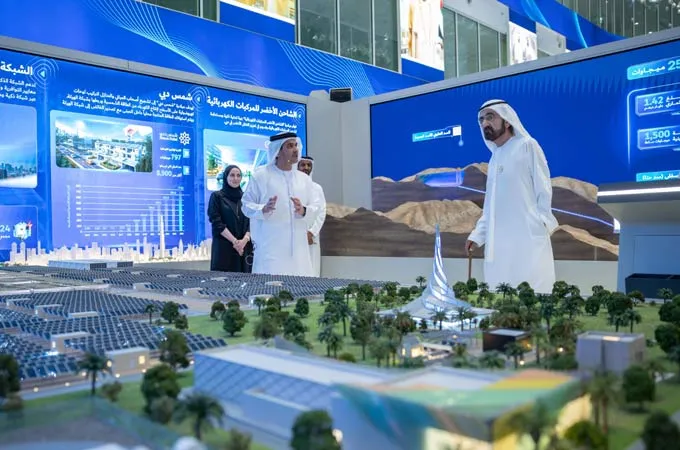
During his tour of the building, Sheikh Mohammed was briefed by Saeed Mohammed Al Tayer, MD and CEO of DEWA, on the advanced cognitive system that distinguishes the building and makes it the smartest government building in the world. The system relies on Internet of Things technologies, big data analytics and artificial intelligence (AI).
Al Shera’a is equipped with an integrated cognitive system connecting all operational systems and supported by more than 110,000 smart sensors that monitor environmental and operational data in real time, over 1,500 wireless access points and more than 3,200 network devices to achieve perfect synchronisation. These generate more than 1.9 million automated control commands daily, enhancing operational integration, and improving performance efficiency.
He said: “The building reflects our firm commitment to supporting the objectives of the Dubai Clean Energy Strategy 2050 and the Dubai Net Zero Carbon Emissions Strategy 2050 by enhancing resource efficiency, reducing emissions and accelerating the transition towards a green economy based on innovation and sustainability. Al Shera’a redefines the government work environment by leveraging AI and cognitive systems to transform data into decisions and processes into intelligent systems that learn and adapt.”
All systems within the building are integrated through the AI-powered ‘Al Shera’a’ smart app, which serves as a unified control interface for approximately 100 independent systems operating seamlessly together.
Independent systems controlled by the Al Shera’a app include smart parking management, dynamic spaces, access management, elevator experience, HVAC, lighting and audio systems, air quality monitoring, resource booking, shared mobility and asset location services.
The app features 167 independent operating functions delivered through a user-friendly interface focused on user experience, employee wellbeing, quality of life, optimal resource management and proactive maintenance. The building’s digital intelligence enables automatic management of resources based on actual usage, enhancing operational efficiency and sustainability.
The building’s total electricity generation capacity is put at 5 MW, generated by two photovoltaic systems. The first comprises Building Integrated Photovoltaic (BIPV) panels installed on the facade, with 251 panels covering approximately 9,000 sq ft, offering a total capacity of 187 kWp. The second system includes approximately 8,400 photovoltaic panels installed on the roof, podium fins, ground level and shading structures, covering more than 200,000 sq ft and providing a total capacity of approximately 4.821 MW. Specialised robotic systems are used to clean the solar panels and enhance efficiency.
The building is directly connected to Al Jaddaf Metro Station via a dedicated pedestrian bridge, encouraging the use of public transport, reducing congestion and lowering carbon emissions.
The name ‘Al Shera’a’ (Arabic for ‘sail’) symbolises movement, progress and openness, reflecting DEWA’s commitment to innovation and sustainability. The interior design is inspired by traditional Emirati houses, presenting an architectural model that blends authenticity with innovation in a contemporary style, a statement said.
Al Shera’a comprises 19 floors in addition to the ground floor and a basement and has a built-up area of more than 2 million sq ft. It was designed to achieve LEED Platinum certification (Leadership in Energy and Environmental Design) and WELL Gold certification, the leading global standard for healthy and people-centric buildings. The building presents a global model for future buildings that combine AI, resource efficiency, sustainability and quality of life.
Al Shera’a includes a conference hall, training rooms, an innovation centre, exhibition spaces, a nursery for employees’ children, and sports facilities, creating a comprehensive model that leverages advanced AI applications to enhance employee happiness and wellbeing.
Al Shera’a delivers an integrated workplace that combines comfort, flexibility and operational efficiency through intelligent design and automated management of spaces and resources. The integration of smart systems enables environmental conditions and facility operations to adapt to actual usage, supporting sustainability while creating a highly organised and future-ready workplace.