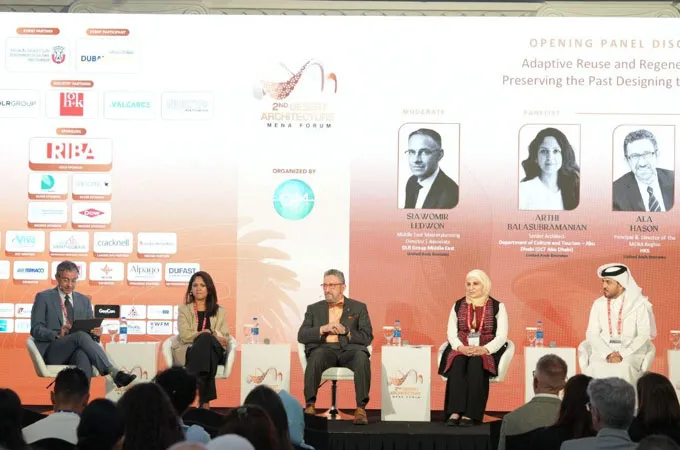
Leading architects, urban planners, government officials and sustainability specialists gathered in Dubai on the opening day of the Desert Architecture MENA Forum 2026 to discuss how desert cities can balance development with cultural preservation and environmental sustainability.
Held under the theme "Integrating Heritage with Innovation: The Future of Desert Living," the two-day forum kicked off today (June 18) focused on strategies to build climate-resilient communities while maintaining regional identity and heritage.
The panel discussions on the opening day examined topics including the adaptive reuse of heritage buildings, regenerative urban development, climate-responsive architecture, sustainable hospitality design, high-performance building façades and the role of natural landscapes in supporting biodiversity and urban liveability.
Speaking at the launch, Ala Hason, Principal & Director of the Mena Region at HKS, said: "Desert architecture is entering a new era where sustainability, cultural identity and human wellbeing must be considered together. The region has an opportunity to lead globally by combining traditional environmental wisdom with advanced design technologies to create communities that are resilient, efficient and deeply connected to their surroundings."
"The future of desert living is not simply about adapting to climate challenges, but about designing places where people and nature can thrive together," he added.
The participants at the Desert Architecture MENA Forum also explored how traditional desert knowledge can help shape the cities of the future, alongside emerging technologies, innovative construction materials and smart design strategies that enhance thermal comfort, improve energy efficiency and support long-term sustainability.
It featured high-level panel discussions, expert presentations and industry innovation sessions dedicated to shaping the future of desert architecture across the Middle East and beyond.
Abdullatif Al Jasmi, Director of Cultural Heritage Protection, Qatar Museums said: "Our architectural heritage offers valuable lessons for addressing many of today’s environmental and urban challenges. Traditional desert settlements were designed with a deep understanding of climate, materials and community needs. Preserving and learning from this heritage is not only essential for safeguarding cultural identity, but also for inspiring innovative approaches to sustainable development."
"By integrating heritage into contemporary planning, we can ensure that future generations remain connected to the stories, knowledge and values that shaped our region," he stated.
Arthi Balasubramanian, Senior Architect, Department of Culture and Tourism – Abu Dhabi (DCT Abu Dhabi), said: "Adaptive reuse is one of the most effective ways to preserve cultural heritage while responding to the environmental and social needs of contemporary communities. By thoughtfully revitalising existing buildings, we can extend their lifespan, reduce the environmental impact of new construction, and create spaces that remain relevant for future generations."
"The challenge is not simply to conserve the past, but to ensure that heritage continues to evolve as a living part of our cities, contributing to community identity, economic vitality and long-term sustainability," she added.-TradeArabia News Service