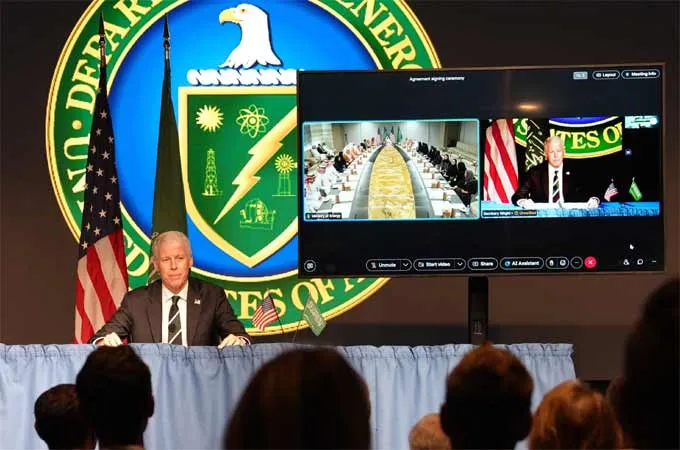
US Secretary of Energy Chris Wright and Saudi Minister of Energy Prince Abdulaziz bin Salman have signed a peaceful nuclear cooperation agreement, commonly known as a 123 agreement, alongside an accompanying bilateral safeguards agreement.
Together, these two agreements lay the legal foundation for a decades-long, multi-billion-dollar partnership that advances several priority economic and strategic objectives, including nuclear non-proliferation, said the US Department of Energy.
The 123 agreement provides great access for American companies in the Saudi nuclear energy programme, benefiting American industry, workers, and supply chains while helping to meet Saudi energy needs, it said.
The two agreements also advance US and regional security by upholding high standards of nuclear safety, security, and non-proliferation and strengthening the United States' competitive edge in civil nuclear technology.
"These agreements reflect our two nations' shared commitment to strengthening US-Saudi commercial relations, delivering prosperity at home and security to our allies abroad," said Secretary Wright.
"Rest assured, these agreements uphold the highest standards of nuclear safety and non-proliferation, while relying on the world's best nuclear technology and scientists, designed right here in the United States. Thanks to President Trump, the American nuclear renaissance is underway and will deliver long-term benefits to the American and Saudi people."
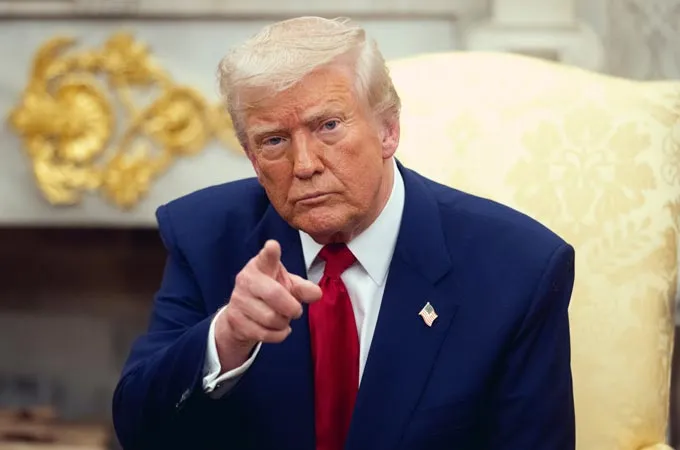
Earlier, US President Donald Trump approved a 30-year civilian nuclear cooperation agreement that could eventually allow the kingdom to enrich uranium for its nuclear energy programme under a modified oversight framework, CNN reported.
The deal will now be sent to the US Congress for review. CNN said the agreement had remained on hold for months because of concerns within the administration over the conflict with Iran and the possibility of opposition in Congress.
Under the arrangement, a joint US-Saudi team would first assess whether uranium enrichment in the kingdom is commercially viable and necessary. If the project proceeds, American firms would build the enrichment facility while retaining control over sensitive technology, according to CNN.
The report said Saudi Arabia would be barred from independently developing uranium enrichment technology or acquiring it from third countries for the first 10 years of the agreement, citing details first reported by The Wall Street Journal.
The agreement does not require Saudi Arabia to adopt the International Atomic Energy Agency's (IAEA) Additional Protocol — widely regarded as the international "gold standard" for nuclear safeguards. Instead, it provides for a bilateral safeguards arrangement that US officials told CNN is designed to address Saudi concerns while maintaining oversight. The new safeguards framework would still require approval from the IAEA Board of Governors.
According to CNN, both the Trump and Biden administrations pursued civilian nuclear cooperation with Saudi Arabia. Under former President Joe Biden, such an agreement was linked to broader efforts to advance Saudi-Israeli normalisation, but those negotiations stalled following the October 7, 2023, Hamas attack on Israel. The Trump administration later revived the discussions.
Separately, The Wall Street Journal reported that the agreement could generate billions of dollars in business for the US nuclear industry. US Energy Secretary Chris Wright discussed expanding Saudi Arabia's commercial nuclear power programme during a visit to the kingdom last year, ahead of President Trump's trip to Saudi Arabia.