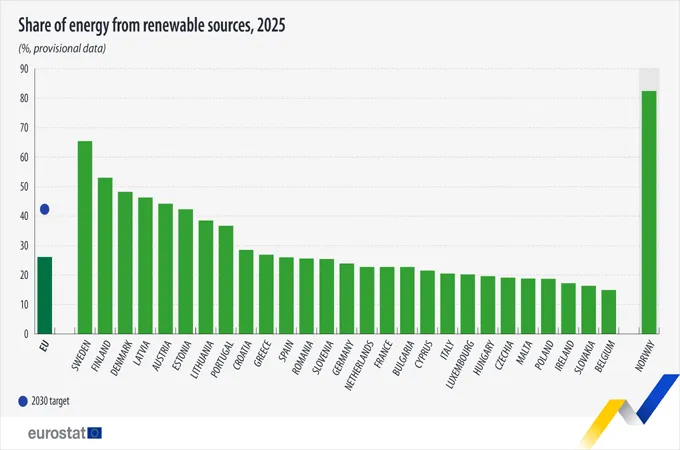
Renewable energy accounted for 26.2 per cent of the European Union’s (EU) gross final energy consumption in 2025, according to Eurostat, the European Statistical Office, up from 25.2 per cent in 2024.
The increase continues a long-term upward trend from 9.6 per
cent in 2004, but the bloc remains behind its 2030 target of 42.5 per cent.
To meet the target, the EU would need to increase renewable
energy’s share by an average of 3.3 percentage points annually between 2026 and
2030, highlighting the scale of the transition challenge.
Sweden recorded the highest renewable energy share among EU
member states at 65.4 per cent, driven mainly by solid biomass, hydropower and
wind.
Finland followed with 53.0 per cent, supported by biomass,
wind and hydro, while Denmark reached 48.2 per cent through biomass, wind and
biogas.
The lowest renewable shares were reported in Belgium at 14.9
per cent, Slovakia at 16.3 per cent and Ireland at 17.2 per cent.
Renewables supplied nearly half of the EU’s electricity
consumption in 2025, reaching 49.9 per cent, an increase of 2.4 percentage
points from the previous year and a significant rise from 15.9 per cent in
2004.
Austria recorded the highest renewable electricity share at
90.8 per cent, followed closely by Sweden at 89.2 per cent.
Denmark, Portugal, Greece and Spain also exceeded 60 per
cent.
At the lower end, Malta recorded the smallest renewable
electricity share at 11.2 per cent, followed by Czechia at 19.2 per cent,
Luxembourg at 23.3 per cent, Slovakia at 24.1 per cent and Cyprus at 27.5 per
cent.
Renewable energy use in heating and cooling also continued
to expand, reaching a record 27.4 per cent in 2025, compared with 26.7 per cent
in 2024.
While growth remains steady, the increase of 0.7 percentage
points was slightly below the historical annual average rise of 0.75 percentage
points since 2004.
The data highlights continued progress in Europe’s clean energy transition, while underscoring the need for faster deployment to meet future targets. -OGN/TradeArabia News Service