Volatility creates opportunity and it is the leadership’s ability to convert challenges into opportunities that makes a difference in people’s lives, officials told more than 500 accounting professionals.
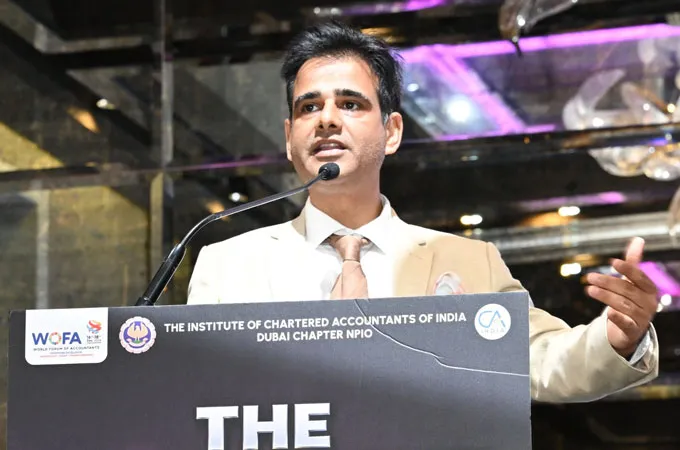
The view came at a conference titled: The Executive Edge: Practical Skills for High-Impact Finance Professionals, organised by the Dubai Chapter of the Institute of Chartered Accountants of India (ICAI).
Good leadership drives measurable economic value by boosting financial performance, increasing innovation, and building resilient organisations. Organisations that invest in leadership development see 147% higher earnings per share than peers with weak leadership.
Powerful foundation
“Chartered Accountants are trained to understand numbers, question risks, analyse businesses and uphold strong governance — qualities that form a powerful foundation for entrepreneurship and leadership. The opportunity is to take these strengths beyond the traditional professional role and use them to build, lead and transform businesses,” CA Rishi Chawla, Chairman of the Dubai Chapter of the ICAI, said in his opening remarks at the conference.
“This strong professional foundation positions Chartered Accountants to go even further. Many already play a critical role as CFOs and trusted advisors, shaping some of the most important decisions in an organisation. The next opportunity is to see more Chartered Accountants step into entrepreneurial and business leadership roles themselves. With their ability to understand the top line, protect the bottom line and identify the fault lines of a business, CAs have a unique advantage to not only advise businesses—but to build, lead and transform them.”
The role of the accounting professionals became more crucial in the financial management of businesses following the Global Financial Crisis of 2008-09 that saw many of the Chartered Accountants taking over the leadership of businesses as CEOs and rescuing them from bankruptcy.
Preparedness for the future
Rajeev Kakar, Global Banker, Entrepreneur and International Board Director, said: “Leadership is not only limited to strategy and vision, but about preparedness for the future – especially risks and overcoming those challenges. We currently live in a world of Poly-crisis where multiple risks, uncertainties, volatilities, conflicts, regional skirmishes, geopolitics, etc. have become the new norm. We are also expecting to see a lot of economic wars, in the form of economic sanctions and trade restrictions.
“Leadership is not about trying to predict or foresee such risks, but it is about preparedness and for investing in optionality, so that businesses can continue to operate despite any unforeseen disruption, are well-positioned not only to survive, but to find new opportunities in volatility and successfully navigate out of challenges. As a thumb rule, volatility always creates new opportunity if leadership is receptive to conceptualise these from the complex new data points that emerge in such situations.
“Closer to home, we have seen how the UAE leadership has not only excellently steered the country out of each of the crises, but is also creating opportunities for its businesses. The country has similarly emerged strongly from every crisis in the past and it didn’t happen by accident. It happened because the leadership has always been prepared for it, not because they could foresee it but because smart leadership always invests for resilience and optionality, as an investment and precaution against such severe, but plausible risks, on a forward looking basis.”
Be data-informed
Referring to the accounting professionals, he said: “Don’t become data-dependent, but be data-informed and take decisions using it, but also use your own gut - as data and intuition together creates compressed experience, needed for better decision making.
“Often finance professionals spend months on models to allocate financial capital, but very little time on allocating or identifying human capital. Here lies a weakness, as it is the people and their behaviour that are more important than the numbers. So, invest in people, and the story behind the numbers, not only in the balance sheet.
“It is this insight that creates businesses, not numbers. Communication is not only about how to talk and present but, importantly, also on how to listen - and a good leader must not only talk well and listen well, but also be a coach who facilitates collaboration within his team, and also a mentor who helps constantly enhance the resource levels of the business talent.”
The conference, attended by more than 500 members of ICAI, featured keynote addresses by eminent speakers who urged professionals to focus on their mind, sharpen them and utilise the power of mind.
Making humans lazier
Prof Piyush Kumar Sinha Prof at MICA, Senior Adjunct Faculty, IIM Nagpur, said: “Every advancement of technology has made human beings lazier. The latest scientific developments are making us weaker.”
Citing examples, he said, most people now don’t know road directions due to Google Maps and soon they will forget how to drive cars when the driverless vehicles become the norm.
“We may be moving towards the end of the Age of Information. We are giving in – and not giving out. From the Age of Information, we are moving towards the Age of Imagination. Today everything is done by Artificial Intelligence (AI) – so that we don’t have to. If AI is going to predict and analyse better, what happens to us? The future is leaner and we don’t know what’s going to happen to us in future,” he said.
With more than 3,200 members, ICAI Dubai Chapter is the largest business group in the UAE. Established in 1982, it is also the largest, most active and award-winning chapter among the 44 overseas chapters of ICAI. It has registered a phenomenal growth in membership has exceeded 3,200 members who represent more than 1,550 multinationals and other companies.
Leadership and entrepreneurship
Amit Khaitan, Vice-Chairman of ICAI Dubai Chapter, said, the ICAI wants to promote leadership and entrepreneurship among its members. “We want to see our members create world-class businesses and make their mark not only as great professionals, but nurture their potential to become entrepreneurs and great business leaders,” he said.
ICAI is the largest professional body of Chartered Accountants across the world with over 1,000,000+ students and around 450,000+ members. ICAI has a wide network with five Regional Councils, 176 Branches, 54 Overseas Chapters, and 31 representative offices across the globe.
And among 54 overseas chapters, ICAI Dubai Chapter is the largest and most vibrant chapter of ICAI. Of the 8,000 Indian Chartered Accountants active in the UAE‘s private sector, 1,400+ are currently leading businesses in senior positions.—TradeArabia News Service