Oil prices fell more than 2% on Monday to their lowest levels in more than a week as hopes for renewed US-Iran diplomacy reduced some of the geopolitical risk premium, while President Donald Trump signalled he could meet Iranian President Masoud Pezeshkian but warned Tehran that much bigger action could follow if it did not change course.
Brent crude futures fell $2.16, or 2.08%, to $101.71 a barrel, while US West Texas Intermediate (WTI) crude dropped $2.15, or 2.14%, to $98.15, breaking below the psychologically important $100 level. Both benchmarks touched their lowest levels since September 10.
The latest decline extends a three-session slide in oil prices as traders increasingly focus on the possibility of diplomatic contacts between Washington and Tehran, alongside signs that Saudi Arabia is restoring some of its disrupted crude export flows.
Trump said he would be open to meeting Pezeshkian on the sidelines of the United Nations General Assembly in New York this week. The Iranian president is expected to attend the UN gathering, while Trump is also due to meet Gulf leaders.
The prospect of a meeting has raised hopes that a diplomatic channel could emerge to end or de-escalate the US-Iran conflict, prompting investors to unwind part of the premium that had been built into crude prices because of the threat to Middle East supplies.
But the diplomatic signals remain fragile.
Trump has simultaneously stepped up his warnings to Tehran, saying Iran's leaders must make a deal or face severe economic and military consequences. He told Fox News that he was in “deciding mode” on Iran and warned that “very big things” could happen if its behaviour did not change.
Iran, meanwhile, has warned that any fresh US attack would trigger sustained retaliation against US bases and interests in the region. Iranian military officials have also indicated that Washington's regional allies could be treated as parties to the conflict.
That tension was underscored by a new US security alert urging American citizens to leave Iran immediately, warning that the situation could escalate rapidly and that flight cancellations and airspace closures were possible.
Saudi exports provide some relief
The oil market is also finding some relief from a partial recovery in Saudi crude exports after disruptions to the kingdom's East-West pipeline.
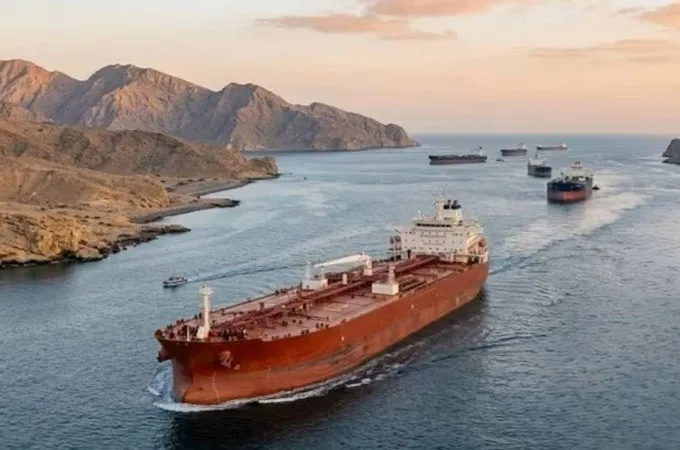
Attacks by Iran-backed Houthi forces on Saudi energy infrastructure have disrupted the normal flow of crude towards the Red Sea export terminal at Yanbu, forcing Saudi Arabia to redirect more oil through the Strait of Hormuz.
Satellite data also showed Saudi oil flows through the Strait of Hormuz averaging about 2.9 million bpd over the past six days, sharply higher than the 700,000 bpd recorded in August.
Overall Middle East oil flows have remained relatively resilient despite the disruptions. JPMorgan analysts estimated that regional flows averaged 17.1 million bpd over the 10 days to September 18.