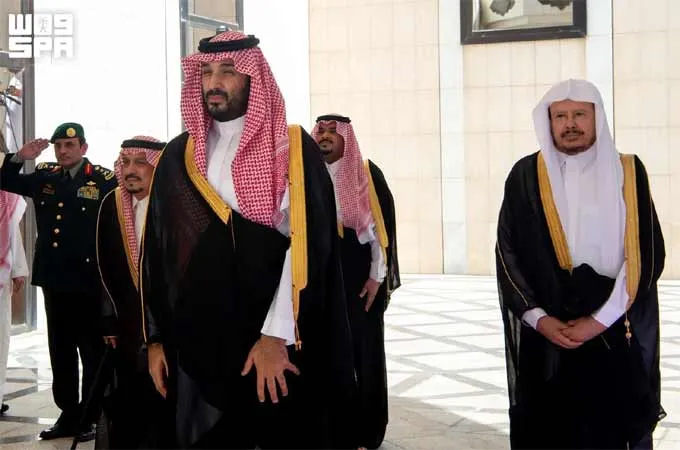
Saudi Arabia has achieved 93% of the targets set for its Vision 2030 programmes and strategies after a decade of reforms that have transformed the Kingdom’s economy and strengthened its resilience to external shocks, HRH Prince Mohammed bin Salman, the Crown Prince and Prime Minister, said on Wednesday.
Opening the third year of the ninth session of the Shura Council on behalf of King Salman, the Crown Prince highlighted strong growth in non-oil exports, a larger private-sector role in the economy and advances in digital government, cybersecurity and logistics.
Non-oil exports have increased 155% compared with 2016, while the private sector’s contribution to the economy has risen to 51%, he said according to a Saudi Press Agency report.
HRH the Crown Prince said Saudi Arabia’s transport and logistics system had demonstrated its ability to respond to disruptions in global supply chains and maintain the flow of goods and services.
The Public Investment Fund has also begun implementing its strategy for the next five years, with a focus on developing competitive domestic economic sectors in partnership with the private sector, increasing local content and generating sustainable financial returns.
The National Development Fund is similarly supporting the development of several sectors through annual financing aimed at meeting their strategic targets.
Saudi Arabia has also advanced in several international technology and governance indicators, ranking first in the Digital Readiness Framework, the ICT Development Index and a cybersecurity indicator, while ranking second in the GovTech Maturity Index. The Kingdom has also entered the world's top 10 jurisdictions for mining investment attractiveness, the Crown Prince said.
The government has designated 2026 as the Year of Artificial Intelligence, underlining its ambition to become a global leader in AI applications and solutions while using the technology to boost productivity, improve public services and develop Saudi talent.
The Crown Prince said the reforms had also produced gains in employment, housing, education and healthcare.
Real estate reforms had expanded housing choices, improved market efficiency and increased homeownership, while investment in human capital was aimed at creating greater opportunities for Saudi citizens to enter and compete in the labour market.
He said education and healthcare remained among the government's top priorities, with the General Education Law intended to raise educational standards and a continuing healthcare transformation aimed at improving service quality and coverage.
The Crown Prince said the changes of the past decade had demonstrated the importance of economic diversification as the Kingdom faces an increasingly uncertain global environment.
“Long-term planning does not mean rigidity or stagnation; it means the ability to adapt to changing circumstances,” he said.
He said the resilience of the national economy, the maturity of the business sector, the strength of state institutions and fiscal sustainability had been demonstrated by current regional conditions.
Saudi Arabia's economic policy would continue to focus on developing national capabilities, supporting promising sectors, attracting domestic and international investment and directing resources towards areas with the greatest economic and social impact, he said.
Gulf security
Turning to regional security, HRH the Crown Prince said recent attacks targeting GCC states had demonstrated that Gulf security and stability were indivisible.
Saudi Arabia would continue working with other Gulf states to strengthen security, strategic cooperation and economic integration, he said, while pursuing closer joint action through the GCC.
He also referred to the Makkah Joint Defence Agreement between Saudi Arabia, Türkiye and Pakistan, saying it reflected a shared commitment to regional security and stability.
The Crown Prince thanked countries that had supported Saudi Arabia and contributed to regional peace and stability.
Against the backdrop of disruption to global energy markets, he said Saudi Arabia had continued to provide oil supplies to international markets despite escalating tensions, describing the Kingdom as a safeguard for global energy security.
Saudi Arabia had also taken the initiative to establish a Multinational Maritime Defense Alliance aimed at strengthening maritime security, protecting shared interests in international sea lanes and preventing their use as a means of political or economic pressure.
The Kingdom, he said, was working with international partners to strengthen cooperation, reduce escalation and defuse tensions.
He also called on the international community to fulfil its responsibilities to ensure the safe flow of essential goods and humanitarian assistance.