AI is driving up telemetry volumes for organisations in the UAE and Saudi Arabia, according to the new Dynatrace State of Observability 2026 report.
Some 46% of UAE respondents and 43% of Saudi respondents say AI has increased the volume of telemetry data they manage, compared with 33% globally.
The findings also highlight distinct challenges for organisations in each country. Only 32% of UAE respondents say observability has helped them detect and resolve issues faster, against 52% worldwide, while 35% of Saudi security respondents fully remediate critical vulnerabilities within 24 hours, compared with 28% globally.
Not working as intended
AI can be available and responsive but not working as intended, a distinction that matters more as AI moves deeper into production. The research highlights a gap between AI ambition and execution across quality, agent behaviour, security, cost, and business impact.
Closing it requires observability that can verify AI behavior and its effects throughout the technology estate.
Globally, the research exposes a tension in enterprise AI: 87% use AI agents for observability and IT operations, while 44% target fully autonomous operations within five years, compared with 12% today.
Yet respondents say humans verify an average 66% of AI-powered decisions, and only 27% currently address visibility into how agents decide and act. That shortfall reflects a broader pattern: across nine AI observability capabilities, execution trails perceived importance by an average of 14 percentage points.
For technology leaders, this execution gap is the area to watch: organisations are preparing AI agents to do more before many can clearly establish how those agents reached a decision.
Meeting these challenges requires two complementary capabilities:
•Observability of AI establishes evidence about AI behaviour, quality, security, cost, and impact.
•AI-powered observability applies causal analysis, automation, and agents to improve operations and advance autonomy.
One helps determine whether AI is working as intended; the other helps people and agents operate the wider technology estate.
UAE
In the UAE, the strain comes from data and AI behaviour. Alongside rising telemetry volumes, nearly half of respondents (49%) say unpredictable AI behavior has added complexity, and 45% point to managing multi-cloud environments. The gap shows most in results. Only 32% say observability has helped them detect and resolve issues faster, compared with 52% globally, and a third say it has helped move AI projects from pilot to production. Security teams are under similar pressure, with 38% missing their own targets for fixing critical vulnerabilities, the highest share of the 12 markets surveyed.
Saudi Arabia
In Saudi Arabia, only a quarter of Saudi respondents say AI has made their technology environment more complex, about half the global figure, although 43% say it has increased the number of monitoring tools they need. Fewer cite the cost or volume of observability data than globally, and governing sensitive data within observability pipelines is the challenge that stands out, cited by 37%. Reported outcomes are more even, with 48% saying observability has helped move AI projects from pilot to production. Saudi security teams also report faster remediation: 35% fix critical vulnerabilities within 24 hours, compared with 28% globally.
What the State of Observability 2026 reveals globally
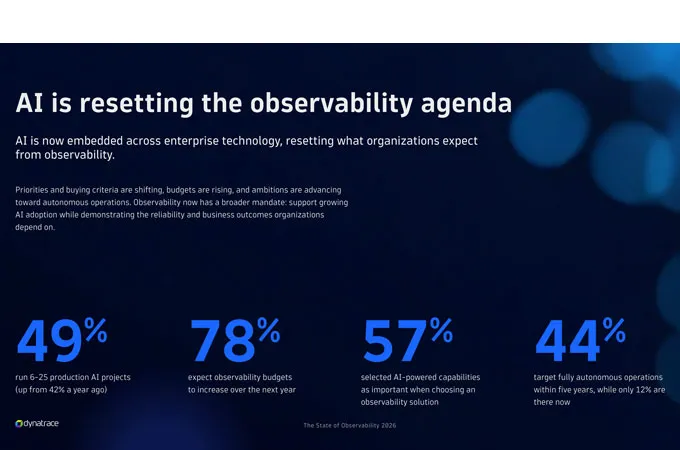
Some 78% expect observability budgets to increase; among them 96% say AI adoption is at least a moderate driver. AI is changing what organisations require from observability.
About 43% cite AI, LLM, and agentic workload expansion as a leading source of technology complexity. AI adds new demands to already complex technology estates.
About 43% consider agent-decision visibility important; only 27% currently address it. AI requires evidence that extends beyond conventional system health.
Some 44% target full autonomy within five years; 12% report reaching that level today. Greater AI authority increases requirements for validation, integration, governance, and oversight.
Runtime security: 55% of security respondents experienced a zero-day incident in the previous year. Security teams need runtime evidence to prioritise actual exposure.
Open standards: 77% have moved OpenTelemetry beyond evaluation; 20% have made it a strategic standard. Open standards help maintain telemetry continuity across environments and lifecycle stages.
Observability establishes the fact basis for reliable AI decisions and measurable outcomes
Context-aware observability connects AI behaviour with the systems, risks, costs, and outcomes around it. This awareness gives leaders a stronger basis for three decisions:
*Where AI is delivering enough value to expand
*Where greater authority is warranted
*Where risk or cost requires intervention
The opportunity is to make those decisions faster with reliable evidence of how AI behaves and what changes as a result.—TradeArabia News Service