The US-Iran deal should allow a return of container shipping to the Strait of Hormuz, but the scale of disruption caused by the blockade puts a recovery of ocean supply chain networks at mid-September 2026, in a best-case scenario, says Xeneta, an ocean and air freight intelligence platform.
The spot rates is expected to rise for at least another four weeks before the market peaks, it said.
“This agreement should be greeted with realism and extreme caution,” said Peter Sand, Chief Analyst at Xeneta.
“Even if the ceasefire holds, around 10% of global container shipping capacity is impacted by the blockade and freight rates are spiralling across major trades. This scale of disruption and market volatility cannot be reversed overnight.”
The scale of disruption
Before the crisis, 99 container services operated in or transited the Arabian Gulf, deploying a combined nominal capacity of 3.2 million TEU – around 10% of the global container fleet. Only 11 services remain active due to the blockade — 10 operating intra-Arabian Gulf and one dedicated Iran-China service — representing just 74,000 TEU of active capacity in the region.
As many as 488 vessels were deployed on those 99 services before the conflict escalated at the end of February; just 18 remain on Arabian Gulf routes today, with 470 ships operationally diverted or displaced across the global network.
The ripple effects of this disruption are visible in spot rates across all major trade lanes – even those that do not ordinarily transit Strait of Hormuz, such as the Transpacific to US West Coast.
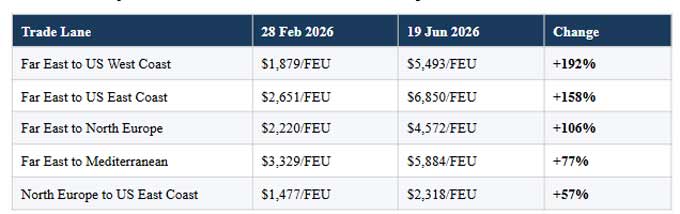
In the past week alone, rates jumped a further +29% on Far East to US West Coast and +25% on Far East to US East Coast.
Sand said: “Shippers are frontloading imports ahead of bunker fuel surcharge increases in July and fears over available capacity, with many being told ships are full on trades out of Asia for weeks in advance. Shippers who manage to get their boxes on board are paying a premium to do so.”
The fuel surcharges pressure ought to ease soon, as marine bunker fuel and oil prices in general have dropped around 20% in the last 10 days.
Rates are yet to peak
The US-Iran deal does not unlock the strait immediately. Articles 4 and 5 of the Memorandum of Understanding address the US naval blockade and Iran’s obligations not to disrupt traffic, but the agreement sets a 30-day window for minesweeping operations – it may well take much longer. Until those operations are complete, safe and broad-scale transit through normal ship separation schemes cannot resume.
“Spot rates will keep climbing for as long as the Strait of Hormuz is not fully open,” Sand said. “That could be four more weeks or longer depending on how complex the de-mining operation turns out to be. Shippers should plan for a peak around the point the strait formally reopens, followed by a gradual easing.”
A three-phase recovery
Xeneta expects recovery in three stages.
Phase zero is the immediate priority of extracting ships and crew stuck inside the Arabian Gulf for almost four months. For example, CMA CGM DIAMOND (3,700 TEU capacity) entered the Gulf on February 17, and has been trapped ever since, making one unsuccessful attempt to exit the Strait on April 18.
Phase one covers the return of feeder and regional services into Arabian Gulf ports. These smaller services carry lower risk if disrupted and will form the foundation for reactivating intra-regional trade. As feeder connectivity is restored, intra-Arabian Gulf services — which have fallen from 21 pre-crisis to 10 today — can begin to expand again.
Phase two will be the return of major long-haul services on the Asia-Europe and Asia-North America trades. These carry the highest volume and the greatest supply chain risk if there is a sudden deterioration in the security situation.
Sand said: “Carriers had to act fast when the conflict escalated and the Strait of Hormuz closed in February, but the return will be far more cautious. A sudden deterioration in the security situation would have the most severe network-wide impact if it causes a failure on a mainhaul Asia-Europe or Asia North America string, so carriers will start with smaller, lower-risk feeder services.”
The next normal may look different
Even after full recovery, the Middle East container shipping service set-up will not be a carbon copy of what existed before February 28. Xeneta expects carriers to build more resilience into networks — favouring a higher proportion of regional feeder services relative to major East-West fronthaul calls.
Sand said: “The geo-political situation will remain fragile for the foreseeable future and both carriers and shippers will want to protect against the disruption caused by the closure of the Strait of Hormuz first time round. Increasing use of transshipment services into the Gulf creates additional transit time, but it insulates the long-haul network from future disruption.” -TradeArabia News Service