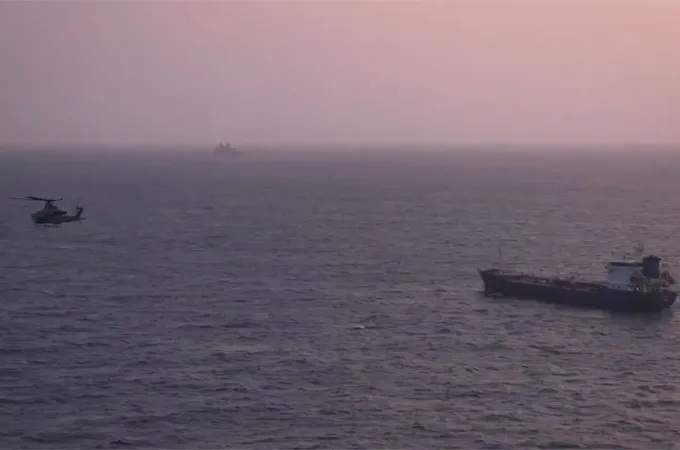
The United States has lifted its naval blockade of Iran and commercial shipping has begun cautiously returning to the Strait of Hormuz after Washington and Tehran signed an interim agreement aimed at ending months of conflict in the Gulf.
The move marks the first tangible implementation of the US-Iran memorandum of understanding signed on June 17, which sets out a roadmap for restoring maritime trade, reducing tensions and negotiating a longer-term settlement.
US Central Command confirmed on X that it had ended the blockade "in accordance with the President's direction", while adding that some US naval assets would remain "in the general area" to monitor developments.
The agreement calls for commercial traffic through the Strait of Hormuz to resume immediately. Shipping data from MarineTraffic showed at least seven vessels transiting the strategic waterway on Thursday, signalling the first steps towards reopening one of the world's most important energy corridors.
Under the terms of the agreement, the United States has until July 19 to fully lift restrictions on Iranian ports, while Tehran is expected to make its "best efforts" to restore shipping volumes to pre-war levels during the same period.
The easing of maritime restrictions came as Iran's Supreme Leader Mojtaba Khamenei publicly endorsed the agreement, despite indicating he had reservations about the deal. In remarks carried by Iranian media, Khamenei said he approved the accord after receiving assurances from President Masoud Pezeshkian that the rights of the Iranian people would be protected.
He suggested that future face-to-face negotiations between Tehran and Washington were possible but stressed that such talks would not amount to accepting the US position.
US President Donald Trump did not directly respond to Khamenei's comments but said on Truth Social that he expected ceasefires to take hold "on all fronts", including between Israel and Iran-backed Hezbollah in Lebanon. He also called on regional countries to maintain support for ongoing negotiations.
Behind the scenes, both sides are now working on detailed proposals to implement the agreement. Multiple sources familiar with the discussions said US and Iranian officials have begun laying the groundwork for the next phase of negotiations, with a 60-day window set to finalize a comprehensive settlement aimed at permanently ending hostilities.
Vice President JD Vance, who is expected to lead the US negotiating team, had been due to travel to Switzerland for technical discussions with Iranian officials. However, the White House said the trip had been postponed because arrangements for the next round of talks had not yet been finalized.
"As the Vice President said at his press conference, the plans for the upcoming technical talks have not been finalized, and the US delegation has been prepared to depart at the first available opportunity. But the logistics of these negotiations have never been simple or predictable," a White House spokesperson said.
Despite the breakthrough, maritime security experts cautioned that the return to normal shipping operations may take considerably longer than political leaders have suggested.
"The statements by the US and Iran are currently unclear and do not offer sufficient information regarding key aspects such as timings and safe routes," Jakob Larsen, chief safety and security officer at the Baltic and International Maritime Council (BIMCO), said.
"Due to lack of details and a history of overly optimistic reassurances, we believe the security situation for the shipping industry remains volatile, and we still consider it very risky for ships to commence transits at this point," he said, urging shipowners to continue conducting detailed risk assessments.
The prospect of increased oil flows through the Gulf nevertheless weighed on crude prices on Friday as traders anticipated additional supply reaching international markets.
Brent crude futures fell 54 cents, or 0.68%, to $78.31 a barrel, while US West Texas Intermediate crude declined 46 cents, or 0.6%, to $76.14 a barrel. The more actively traded August WTI contract slipped 79 cents to $75.06 a barrel.
Analysts estimate that the reopening of regional shipping routes and the easing of restrictions on Iranian exports could eventually release more than 85 million barrels of oil currently stranded across the Gulf, adding fresh supply to a market already expected to face oversupply pressures next year.
While the agreement has delivered an early boost to confidence and lowered immediate fears of disruption in global energy markets, industry observers say the true test will be whether negotiators can translate the fragile ceasefire into a durable peace and restore safe passage through the Strait of Hormuz on a sustained basis.