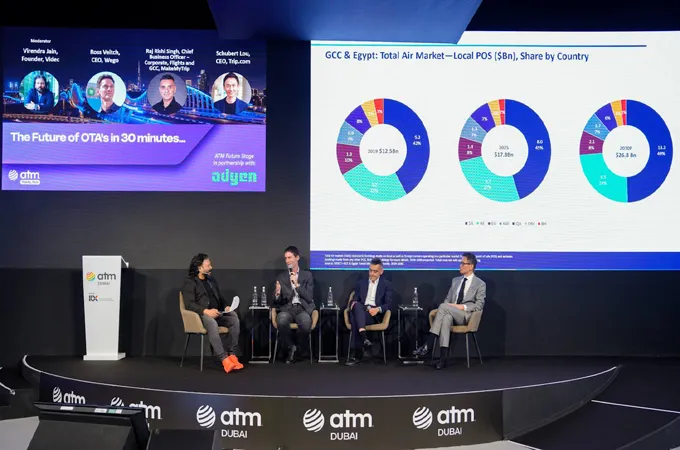
Online travel channels are expected to play a growing role in the UAE’s travel market, with online air penetration forecast to reach 52% by 2030, according to research from VIDEC presented at Arabian Travel Market (ATM) 2026.
VIDEC’s GCC & Egypt Travel Market Sizing & OTA
Benchmarking Study, 2019–2030 examines market growth, travel segments and
distribution trends across the UAE and wider region, including the expanding
role of online travel agencies (OTAs).
The research forecasts that the UAE air market, measured by
bookings made at the local point of sale, will reach $6.5 billion by 2030.
Online penetration is expected to rise from 42% in 2025 to 46% in 2026 and 52%
by the end of the decade, driven by online channels and the recovery of
corporate travel demand.
UAE airports handled around 160 million passengers in 2025,
with low-cost carriers accounting for 35% of traffic. LCC passenger volumes
rose 81%, from 31 million in 2019 to 56 million in 2025. Network carriers
carried 103 million passengers in 2025, compared with 97 million in 2019.
VIDEC estimates the UAE was the region’s largest air market
by gross booking value (GBV), reaching $55 billion in 2025 across local and
global points of sale.
Virendra Jain, CEO and Co-Founder of VIDEC, said: “The UAE’s
travel market opened strong in 2026. Between 2023 and 2025, Emirati carriers
recorded robust growth, particularly the low-cost carriers. That momentum
carried into the first two months of 2026, after which the market saw
significant setbacks.
“Capacity for full-service carriers remains 15–25% below
pre-war levels, while low-cost carriers (LCCs) – local as well as the likes of
Air India Express, flynas and IndiGo – are recovering faster and are expected
to end 2026 closer to their 2025 capacity. Flying point-to-point and catering
primarily to short-haul regional demand, LCCs are leading the rebound as this
segment is the first to return.”
Competition among OTAs is also increasing. MakeMyTrip
remained the leading UAE air OTA in 2026, supported by demand from the South
Asian diaspora and higher fares, while Trip.com has rapidly grown to become the
second-largest air OTA. In hotels, Booking.com and Agoda together account for
around 70% of the market.
Danielle Curtis, Regional Portfolio Director – UAE, RX
Global, said: “VIDEC’s findings demonstrate how technology and changing booking
behaviour are reshaping the UAE travel market. As online penetration continues
to increase, the relationship between travellers, OTAs and travel suppliers is
evolving rapidly, creating opportunities for both established platforms and
newer market entrants.
“Providing access to research of this depth, and bringing
the findings together with perspectives from some of the world’s leading online
travel businesses, is an important part of ATM’s role in helping the industry
understand where the market is heading and identify the opportunities that will
shape its next phase.”
The findings were followed by a panel, The Future of OTAs in 30 Minutes, featuring executives from Wego, MakeMyTrip and Trip.com. Discussions focused on changing consumer expectations, technology, localisation, customer experience and payments. -TradeArabia News Service