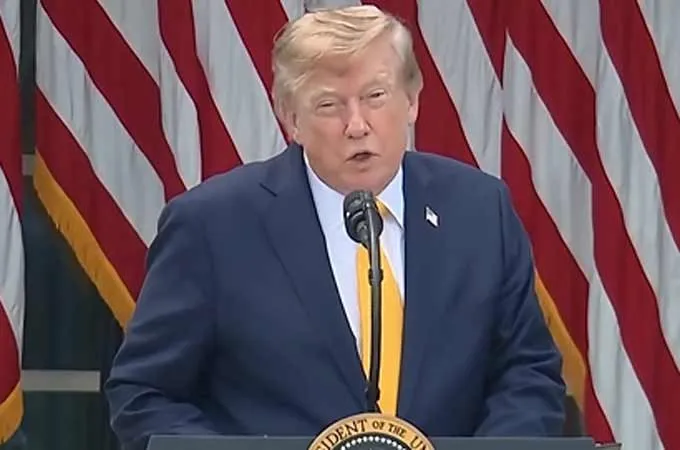
Oil prices fell on Friday after US President Donald Trump said Washington would not attack Iran before the November 3 midterm elections, citing what he described as productive discussions with Tehran and easing concerns over further disruption to Middle East energy supplies.
Brent crude futures fell $1.49 to $102.80 a barrel, while US West Texas Intermediate (WTI) crude futures declined $1.20 to $90.97.
Trump's statement offered a measure of relief to oil markets, which have been grappling with the risk of prolonged supply disruptions since the war between the US, Israel and Iran began in February. However, the prospect of a diplomatic breakthrough remains uncertain, with Tehran and Washington still divided over key nuclear issues and the terms for ending the conflict.
In a post on Truth Social on Thursday, Trump said the US was engaged in productive discussions with Iran but warned that the economic and military pressure on Tehran would continue.
He said the US would not attack Iran before the November 3 congressional elections, while insisting that Iran would not be allowed to develop nuclear weapons.
Trump also claimed that 22 million barrels of oil had passed through the Strait of Hormuz in a single night, without any of the oil originating from or being destined for Iran. He said the blockade would remain in full force.
The US president has repeatedly predicted that oil prices would fall after the midterm elections but has yet to outline a detailed plan for ending the war. His latest remarks, however, provided markets with a signal that an immediate escalation could be avoided.
Oil flows provide a lifeline
The continued movement of crude oil through the Gulf of Oman is helping sustain supplies from Gulf producers and preventing a more severe tightening of the global oil market.
Russell Hardy, chief executive of Vitol Group, the world's largest independent oil trader, said ship-to-ship transfers in the region were critical to maintaining the flow of oil.
Without these transfers, oil prices could reach $200 a barrel, Hardy said at the Energy Intelligence Forum in London this week, adding that there were no more inventories in the West available to draw down.
Ship-to-ship transfers involve smaller vessels carrying oil through the Strait of Hormuz before transferring their cargoes to larger tankers in the Gulf of Oman for onward shipment. These operations have expanded considerably in recent weeks, helping Gulf producers maintain exports despite the conflict and restrictions affecting regional shipping.
Some estimates suggest that oil and petroleum product flows through the Strait of Hormuz have recovered to, or exceeded, pre-war levels of around 20 million barrels per day. The waterway is one of the world's most important energy transit routes, making its continued operation central to the outlook for global oil prices.
The market remains highly sensitive to any threat to these flows. A renewed escalation, tighter restrictions on shipping or a breakdown in negotiations could quickly reverse the recent easing in prices.
Nuclear dispute clouds peace prospects
Despite Trump's assurances, the negotiations face substantial obstacles. Iran and the US have exchanged proposals in recent weeks aimed at ending the war and reopening the Strait of Hormuz, but Trump has rejected Tehran's latest offer.
Iranian state media reported on Thursday that Tehran would not abandon uranium enrichment or surrender its stockpile of enriched uranium, citing the head of the country's Atomic Energy Organization.
The position came days after US Vice President JD Vance told Reuters that Iran must make meaningful reductions in its uranium enrichment capacity.
The dispute over Iran's nuclear programme remains a central point of contention, with Washington insisting that Tehran must not acquire nuclear weapons and Iran refusing to relinquish its stated nuclear rights.