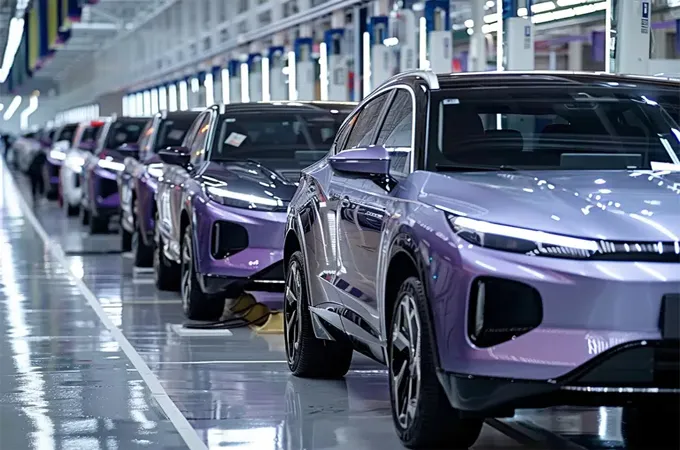
Benchmark Mineral Intelligence, specialising in EV and battery supply chain research and insights, reports that 1.60 million electric vehicles were sold globally in April 2026, bringing YTD 2026 EV sales to 5.6 million.
In April 2026, EV sales grew 6 per cent year-on-year (y-o-y) and decreased by 9 per cent month-on-month (m-o-m).
Charles Lester, Benchmark Mineral Intelligence Data Manager, commented: “The global EV market reached 1.60 million units in April 2026, with growth moderating to 6 per cent year-on-year and declining 9 per cent month-on-month after March’s surge. Year-to-date sales stand at 5.6 million units, marginally down versus 2025, with strong growth in Europe and the RoW offset by continued weakness in China and North America.
“Europe remains the main engine of growth, with sales up 26 per cent year-to-date and April volumes exceeding 400,000 units. Demand continues to be supported by policy incentives, rising petrol prices, and growing Chinese OEM presence.
“China’s market remains under pressure, with sales down 17 per cent year-to-date. While exports are accelerating rapidly, domestic demand, particularly in smaller vehicle segments, continues to be impacted by subsidy changes. North America is still lagging, with sales down 25 per cent year-to-date, although Mexico is seeing stronger growth driven by Chinese imports. Overall, the market is entering a more complex phase, with regional divergence, export growth, and shifting competitive dynamics shaping global trends.”
Europe
Following a record month for EV sales in March 2026, April figures continued to indicate strong growth.
In April 2026, EV sales increased by 27 per cent year-on-year to just over 400,000 units. Year-to-date, sales in France and Germany have risen by 36 per cent and 33 per cent, respectively.
In Italy, EV sales have nearly doubled, supported by government subsidies, with a significant share coming from Chinese manufacturers.
European EV demand continues to be supported by rising petrol prices as a result of the conflict in the Middle East.
During January–February 2026, EV sales growth stood at 19 per cent year-on-year, accelerating to 30 per cent across March–April.
Chinese-built EVs are playing an increasingly important
role in the European market.
In 2025, 19 per cent of EVs sold in Europe were produced in
China; this has risen to 22 per cent so far in 2026 and continues to increase
month by month.
Despite EU tariffs on Chinese BEVs, Chinese OEMs continue to export significant volumes, while also increasingly exploring local manufacturing within Europe.
April 2026 saw a wave of developments involving Chinese OEM production in Europe. Stellantis and Leapmotor announced plans to manufacture Leapmotor’s B10 C-SUV at Stellantis’ Figueruelas plant in Zaragoza, Spain, potentially as early as 2026, alongside a new all-electric Opel C-SUV planned for 2028.
Chinese OEMs, such as SAIC’s MG, are reportedly exploring Volkswagen’s underutilised European capacity.
This follows comments from Volkswagen CEO Oliver Blume on 30 April 2026 that sharing unused factories with Chinese automakers could be a ”clever solution” to address overcapacity.
Meanwhile, Xpeng produced its first locally built P7+ at Magna Steyr’s Graz facility in April, marking its third model manufactured in Europe.
BYD’s Szeged plant continues to ramp up towards mass production.
North America
In North America, EV sales remain relatively subdued in the US and Canada, declining by 25 per cent year-to-date.
In contrast, the Mexican market has grown by nearly 50 per cent, largely driven by Chinese models.
Towards the end of 2025, a significant volume of Chinese EVs was exported to Mexico ahead of the introduction of a 50 per cent import tariff on EVs from countries without a free trade agreement (FTA).
As a result, these vehicles have been entering the Mexican
market in the early months of 2026.
Canada’s EV market is down 7 per cent year-to-date; however, the newly introduced Electric Vehicle Affordability Program (EVAP) is expected to support growth throughout 2026.
Available from mid-February 2026 and running for five years, the programme offers incentives of up to CAD 5,000 (approximately $3,650) for EVs priced below CAD 50,000 (approximately $36,500), with no price cap for vehicles manufactured in Canada.
Earlier in 2026, Canada also introduced a quota allowing 49,000 Chinese EVs to enter without the 100 per cent tariff; the first tranche of 24,500 units is allocated between 1 March and 31 August 2026.
In the US, Rivian has begun customer production of its R2 at its facility in Normal, Illinois.
The company also announced plans to expand its future Georgia plant’s capacity from 200,000 to 300,000 units annually, with production expected to begin in late 2028.
Tesla CEO Elon Musk confirmed that Cybercab production has started, although output is expected to ramp up gradually, with more significant volumes anticipated towards the end of 2026.
China
China’s EV market is down 17 per cent year-to-date. Much of this decline has been concentrated in the smaller vehicle segment, which has been disproportionately affected by subsidy adjustments introduced at the start of the year, reducing the attractiveness of these models.
As domestic growth slows, EV exports from China have surged. In April 2026 alone, exports exceeded 400,000 units.
Over the first four months of 2026, China exported nearly 1.4 million EVs, more than double the volume recorded during the same period in 2025.
Consequently, markets such as Europe, South America, and Southeast Asia have seen a significant increase in EVs produced in China. -OGN/ TradeArabia News Service