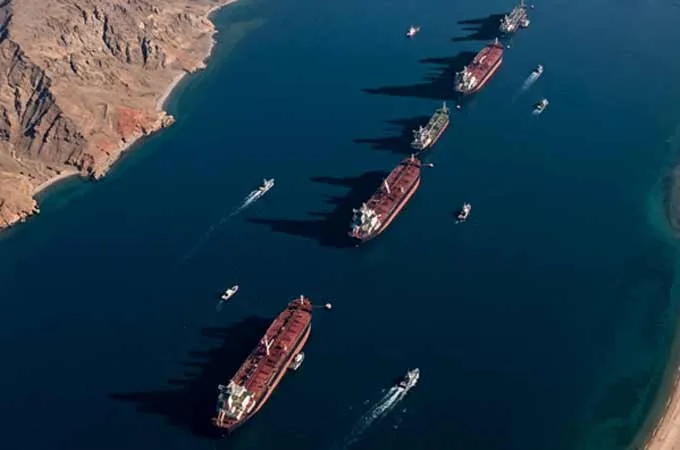
As the world awaits details of a potentially punishing new round of US sanctions against Iran, Tehran has warned that it could shut the Strait of Hormuz and halt all oil shipments through the Arabian Gulf if neighbouring countries join President Donald Trump’s economic campaign against it.
Iran’s top security chief Mohsen Rezaei vowed to “neutralize the economic war” with the United States, signalling that Tehran could respond to Washington’s escalating economic pressure by targeting the vital oil chokepoint.
He said if the US starts such an action, Iran will not allow a single drop of oil to pass through the Gulf, Rezaei said in a televised speech late Saturday.
His warning comes ahead of a major announcement by US Treasury Secretary Scott Bessent, who is due to outline Washington’s next steps against Tehran on Monday.
The Trump administration has been threatening an unprecedented escalation of economic pressure on Iran, with Bessent promising measures that have “never been seen” and Trump describing the campaign as an “ECONOMIC D-DAY”.
The measures could significantly expand the existing US sanctions regime, which has targeted Iran for almost 50 years, although the precise nature and scope of the new restrictions remain unclear.
The threat of secondary sanctions against countries and companies continuing to trade with Iran could prove particularly significant for the Gulf and Asian economies, potentially putting pressure on Iran’s major trading partners to scale back their dealings with Tehran.
Hormuz emerges as Iran’s countermeasure
Tehran appears to be preparing the Strait of Hormuz as its principal economic countermeasure.
Iran has already restricted normal shipping through the waterway while selectively allowing some vessels to pass. It has granted permission for a number of Iraqi oil tankers to transit the strait, according to Reuters, citing Iran’s state-run Islamic Republic News Agency.
Shipping traffic remains well below pre-war levels, although the number of vessels crossing the strait rose 27% in the past week, according to a CNN analysis.
Rezaei said Iran had shipped about 70 million barrels of oil during the past one or two months, despite the US blockade of Iranian ports that resumed in mid-July.
Meanwhile, oil companies have developed increasingly sophisticated ways of moving crude through the strait despite the restrictions.
The US Department of Energy estimates that between 8 million and 9 million barrels of oil a day are still moving through Hormuz, with some tankers making so-called “dark transits” by switching off their transponders.
Under the system, tankers carry crude out of the Gulf through Hormuz and into the Gulf of Oman, where the oil is transferred to waiting vessels before the original tankers return through the strait.
The continuing flow highlights the critical importance of Hormuz to global energy markets — and the potentially enormous consequences if Iran carries out its threat to shut the waterway completely.
Sanctions versus oil flows
The confrontation is increasingly becoming an economic battle in which both sides have powerful tools.
Washington is seeking to squeeze Iran's oil revenues, financial channels and international trade, while Tehran is threatening to impose a cost on the United States and its allies by disrupting one of the world's most important energy corridors.
The stakes are particularly high for the Gulf, with millions of barrels of crude and refined products normally passing through Hormuz every day.