UAE has called for the immediate and unconditional reopening of the Strait of Hormuz, and for Iran to be held fully accountable for its unlawful obstruction of international navigation, a WAM news agency report said.
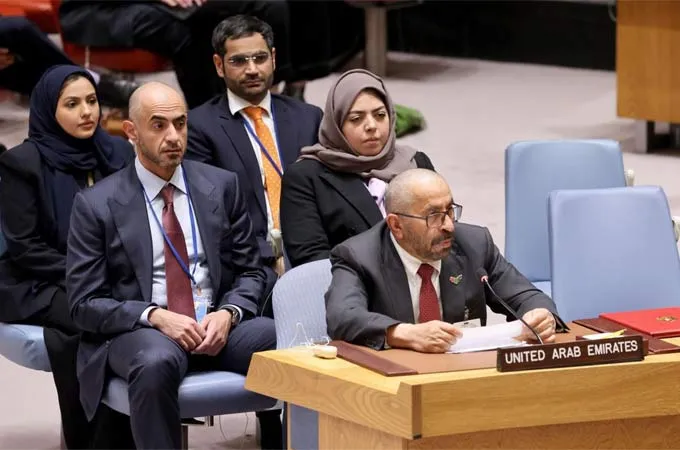
Speaking before the United Nations Security Council High-Level Open Debate on “The Safety and Protection of Waterways in the Maritime Domain”, which was chaired by the Kingdom of Bahrain, Khalifa bin Shaheen Al Marar, Minister of State, said: “Over the past years, the Council has undertaken important steps to address several developments threatening maritime security, most prominently its recent efforts in light of the unprovoked Iranian attacks on the Gulf countries and Jordan, and the threats resulting from the deliberate obstruction of maritime navigation in the Strait of Hormuz by the Islamic Republic of Iran.
"These efforts are reflected through the adoption of Resolution 2817 which condemned any actions or threats by Iran aimed at closing, obstructing, or interfering with international navigation in the Strait of Hormuz."
Al Marar added: “The decisions issued recently by the International Maritime Organisation (IMO) Council, its legal committee, and the UN Human Rights Council, regarding Iran’s actions in the Strait reflect the international community’s position, which demands Iran end its unlawful actions in and around the Strait of Hormuz and to ensure that the Strait remains open with unrestricted transit passage, in accordance with international law.”
He continued: "Allowing Iran to utilise this international Strait as a tool for leverage and political gain would undermine the stability and security required by the international order and global trade. If Iran is permitted to persist in closing the Strait, it would set a dangerous precedent that could erode the freedom of navigation in vital international waterways around the world."
Al Marar outlined the full scope of Iran's unprovoked violations, including the imposition of illegal fees on transiting vessels, launching terrorist attacks and threats against navigation, the laying of mines, and discriminatory treatment of foreign vessels — in a clear violation of the relevant international resolutions, particularly Security Council Resolution 2817.
He stated: “Due to the economic coercion and the flagrant violations of international law, my country holds Iran responsible and affirms that Iran is fully liable to provide reparations for all damages due to its internationally illegal actions, including impacts on the sea and the marine environment.”
He underscored that, due to the vital importance of the Strait, the consequences of its closure are already being witnessed globally and will be significant and far-reaching, impacting energy security, supply chains, and the security of food and essential fertilisers for agriculture, particularly in the Global South, highlighting its grave impact on the global economy.
He said: “Iran’s actions underscore the importance of collective action by the international community to reach a lasting solution to ensure the unconditional and sustainable freedom of navigation and the right of transit passage through the Strait of Hormuz.”
Furthermore, he reaffirmed the UAE’s readiness to participate in all efforts aimed at ensuring the Strait of Hormuz remains open in accordance with international law.
Ahead of the debate, Al Marar participated in a joint press event led by Dr. Abdullatif bin Rashid Al Zayani, Minister of Foreign Affairs of Bahrain, with representatives from more than 90 countries, sending a unified message to the international community for Iran to immediately halt its unlawful actions in and around the Strait of Hormuz and to ensure that the Strait is open and transit passage unrestricted, in accordance with international law.
The participating countries emphasised that Iran’s closure of the Strait and its continued attacks constitute a threat to international security and to navigational rights and freedoms, with consequences at the global level.